Pickleball has taken over tennis courts across Southern California faster than any sport we have seen in fifty years of working on them. HOAs, schools, parks departments and clubs across Riverside, San Diego and Orange counties are all asking the same question: can we convert the tennis court we have, and what does it involve?
We are the wrong company to ask about the lines and the color. We do not surface courts; we strip them, and we have been doing that since 1976. But that puts us in the right place to explain the part of a conversion that gets skipped, because we are the people who get called when a conversion goes wrong.
What a conversion actually is
A standard tennis court fits four pickleball courts, or two with comfortable run-off, or one tennis court with pickleball lines added. Whichever layout you choose, the work on the surface is the same in kind: the old surface is prepared, a new acrylic color system goes down, and the pickleball lines and any new kickboards or net posts go in.
The part that decides whether it works is the first step. Everything else is paint.
Why the old surface matters
A court is a coating problem that repeats on a schedule. Every few years it gets another acrylic color coat, and every cycle adds thickness. On a court that has been recoated five or six times over twenty years, the accumulated system is thick, brittle and, in places, no longer bonded to the slab underneath. It cracks, it blisters where water gets under it, and it holds water in the low spots.
A pickleball conversion laid over that surface inherits every one of those problems. The new color coat bonds to the old one, not to the concrete, and it comes away with it. Cracks in the build-up telegraph straight through the new surface within a season. The court looks excellent on opening day and starts to fail the following summer, which is exactly when a facility manager least wants to explain it. We wrote about the mechanism in when a tennis court needs stripping instead of another color coat.
How to tell which court you have
Before anyone quotes you for a conversion, look at the court honestly.
- Blistering or bubbling anywhere on the surface means water has got under the coating system. It will not recoat.
- Cracks that have been filled and have reopened are moving in the slab or in the build-up, and a new coat will not hold them.
- Delamination at the edges or around the net posts, where you can lift the coating with a fingernail, means the bond has gone.
- Birdbaths, the low spots that hold water after rain, are usually in the coating build-up rather than the slab, and they get worse with each coat.
- A history of five or more recoats is a strong sign on its own, whatever the surface looks like today.
If a court has one or two of these, it is a candidate for stripping back to the slab before conversion. If it has none of them and the surface is sound, a resurfacing contractor can usually prepare and recoat it directly, and it will be a much cheaper job. Either way, the assessment should happen before the layout is chosen, not after the lines are down.
What stripping a court involves
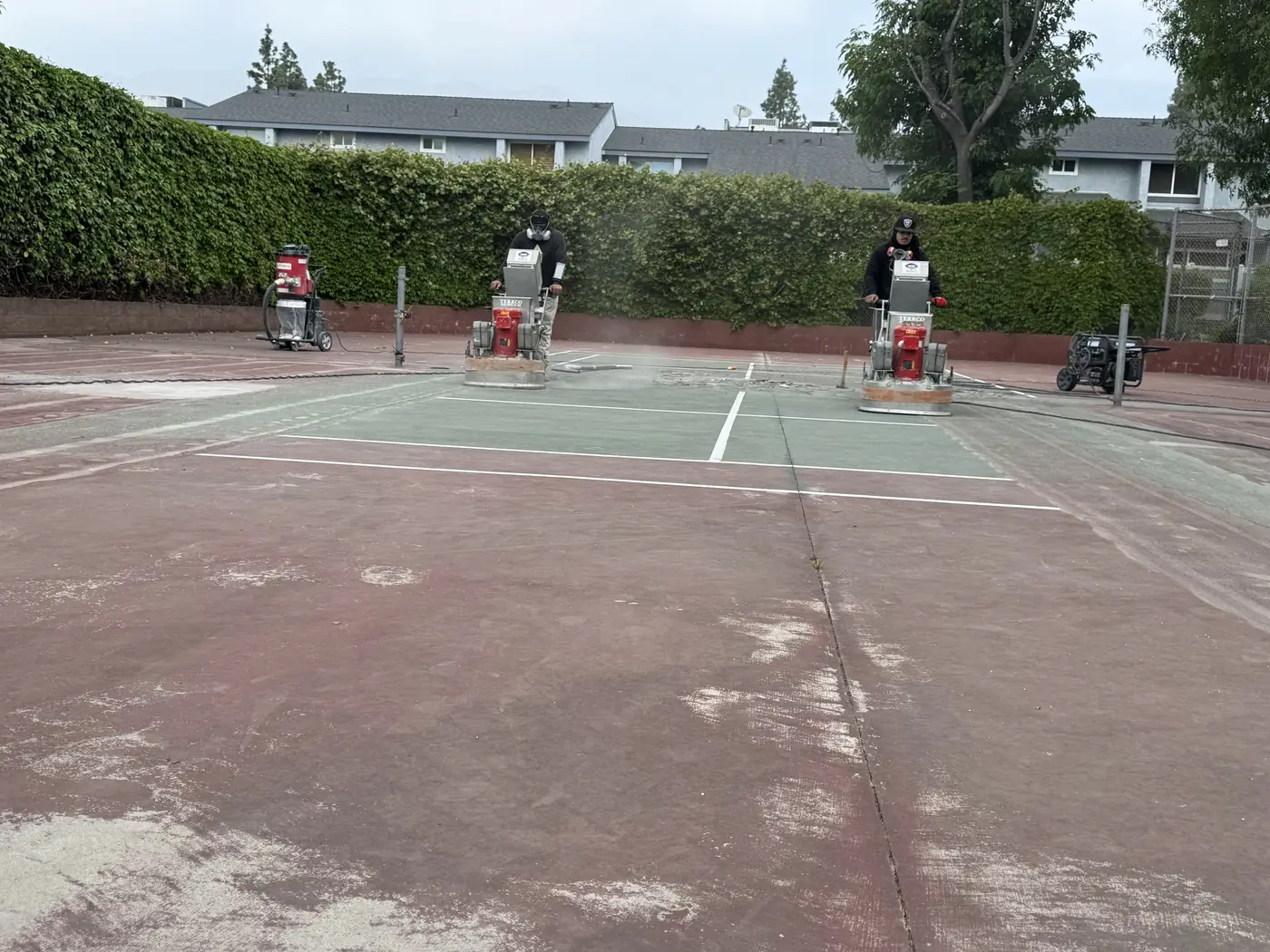
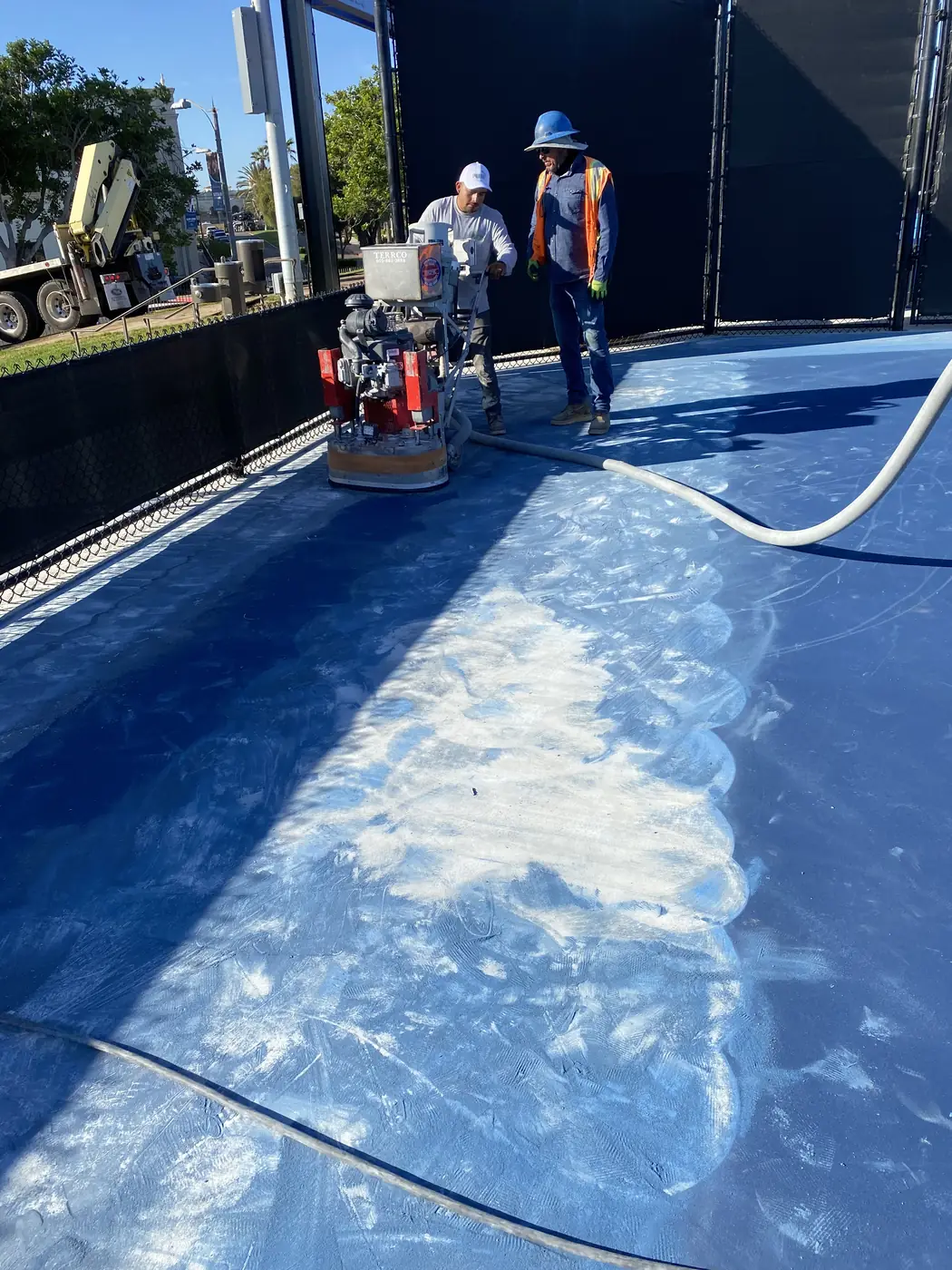
Taking a court back to the slab is a different job from surfacing one, and it needs equipment most surfacing contractors do not own. We grind the accumulated acrylic system off mechanically, right across the court, back to bare, sound concrete with a profile on it that a new surfacing system can bond to. Cracks in the slab itself become visible once the build-up is off, which is often the first time an owner sees the real condition of their court. It is far better to see that then, and have it repaired properly, than to discover it through a brand-new color coat.
What you are left with is a clean slab ready for the surfacing contractor to lay their system on, and a pickleball court that is bonded to concrete rather than to twenty years of paint. Our tennis and pickleball court coating removal page covers the process in more detail.
Who does what
A conversion done properly usually has two contractors on it. We strip the court and hand over a prepared slab. A court surfacing contractor lays the cushion or color system, paints the lines and sets the posts. Plenty of surfacing contractors bring us in for exactly this, because it is a better result for their client and it means their system is going onto a surface they can warrant.
If you are an owner rather than a contractor, we are happy to look at your court, tell you whether it needs stripping or can be recoated, and point you towards people well placed to surface it. We are not competing for the finish work.
Scheduling around a season
Courts belong to somebody's season. Summer breaks, off-season windows and phased work across a multi-court facility are all normal for us. Stripping is the faster part of a conversion, and it can be sequenced so that a facility keeps some courts open while others are worked on. Tell us the dates you actually have and we will tell you honestly whether the work fits in them.
Budgeting it honestly
Stripping adds cost to a conversion, and it is tempting to skip it when the surface looks passable. The arithmetic is simple, though. A conversion over a failing surface has to be done again within a few years, and the second time it has to be stripped anyway, plus the cost of the first conversion is gone. Assessed correctly at the start, a court is stripped once and surfaced once.
We work on courts across Riverside, San Bernardino, San Diego, Orange and Los Angeles counties. If you are planning a conversion, book a free on-site assessment and we will tell you straight what the surface needs. Thousands of courts have been through our crews since 1976, and the ones that last are the ones that started on bare concrete.