Facility managers and business owners nearly always ask for a square-foot price first, and it is a reasonable question for a floor that might be ten thousand square feet. The trouble is that the honest square-foot figure for one warehouse can be half or double the figure for the building next door, because the number is set by what is on the slab, what has to go on it, and whether the business can close while it happens.
This guide is for anyone budgeting a commercial or industrial epoxy floor across Riverside, San Bernardino, Orange, Los Angeles and San Diego counties. It covers the range you will see in quotes, what each part of a floor costs relative to the others, and the questions that separate a cheap quote from a good one.
The range, and why it is wide
Across Southern California, commercial epoxy flooring typically runs from around three dollars per square foot for a thin roll-coat over a sound, bare slab, up to twelve dollars or more for a high-build system with a broadcast, a urethane or polyaspartic topcoat and integral safety striping. Removal of an existing coating, where needed, adds to that.
Those are market figures rather than a price list. We do not publish a square-foot rate because a single number would be wrong for most of the floors we look at, and a floor quoted from a rate rather than a site visit is a floor that gets change orders. Every estimate we do is on site and free.
Where the money goes
Preparation. The largest share, and the only share that decides whether the floor lasts. Every floor is mechanically ground with diamond tooling, or shot-blasted where the slab and the system call for it, before any product goes down. On a commercial slab that also means dealing with oil, forklift rubber, old paint lines and whatever the previous tenant left in the concrete. A coating over a sealed, contaminated or dusty slab has nothing to grip and comes off in sheets, and it takes the striping with it.
Removal. If there is a coating on the floor already, it has to come off, back to sound concrete with a profile on it. This is a service in its own right for us, and we do it for other contractors as well as on our own jobs. It is the line that moves a commercial quote the most, and it is worth knowing what the existing coating is before the estimate if you can.
Repair. Cracks chased and filled, spalled areas ground back and patched, control joints treated for the traffic they will carry. Loading dock aprons and press pits are where this adds up.
The system. A thin-mil roll coat is the least expensive and suits a storeroom or light-traffic back-of-house. A high-build epoxy with a broadcast of quartz or flake and a wear topcoat is the standard for warehouses and plant floors. The topcoat chemistry, epoxy, urethane or polyaspartic, is chosen for the abuse the floor takes: forklift abrasion, point impact, chemical attack and UV are four different problems with four different answers, which we covered in polished concrete vs epoxy.
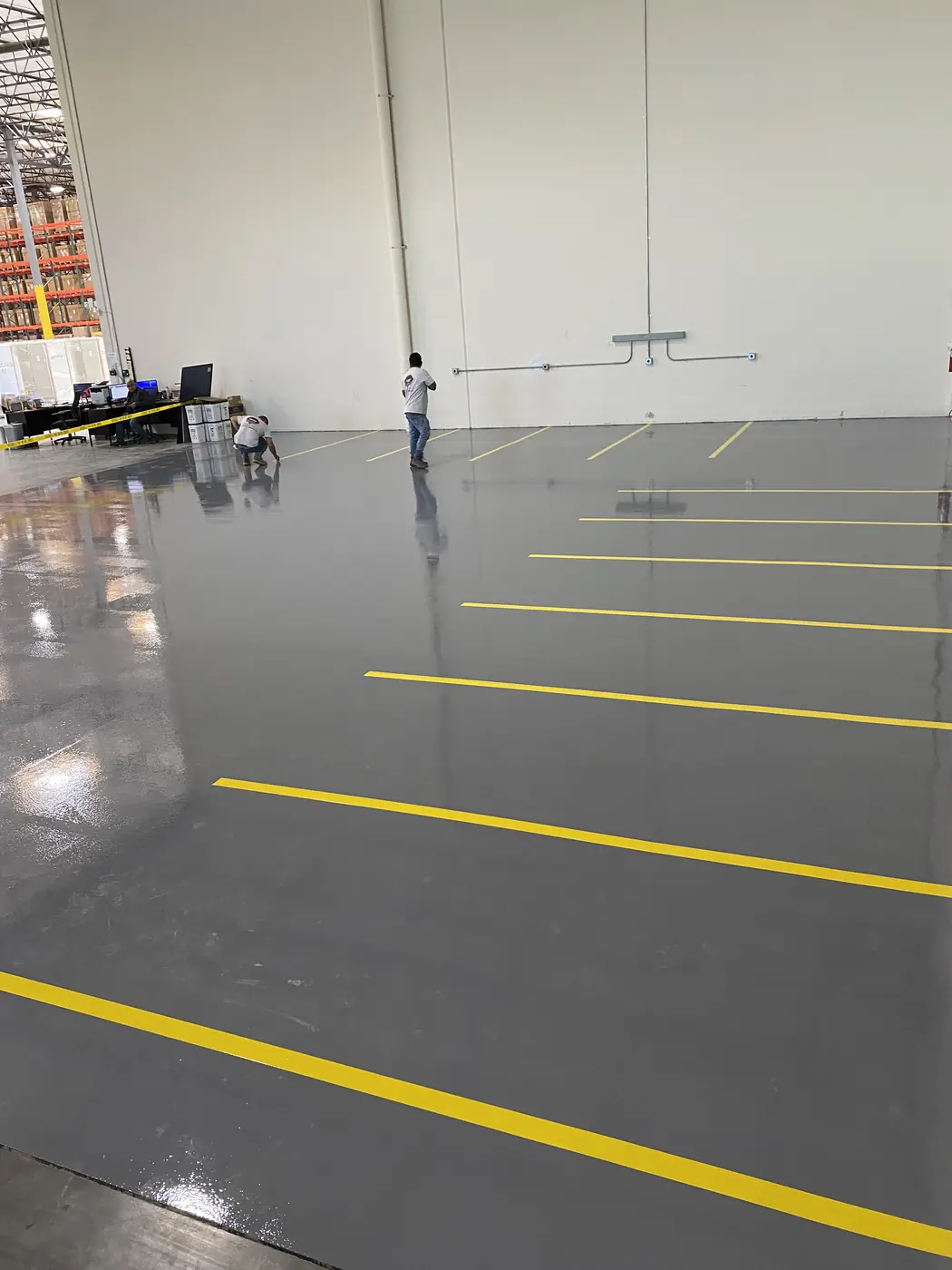
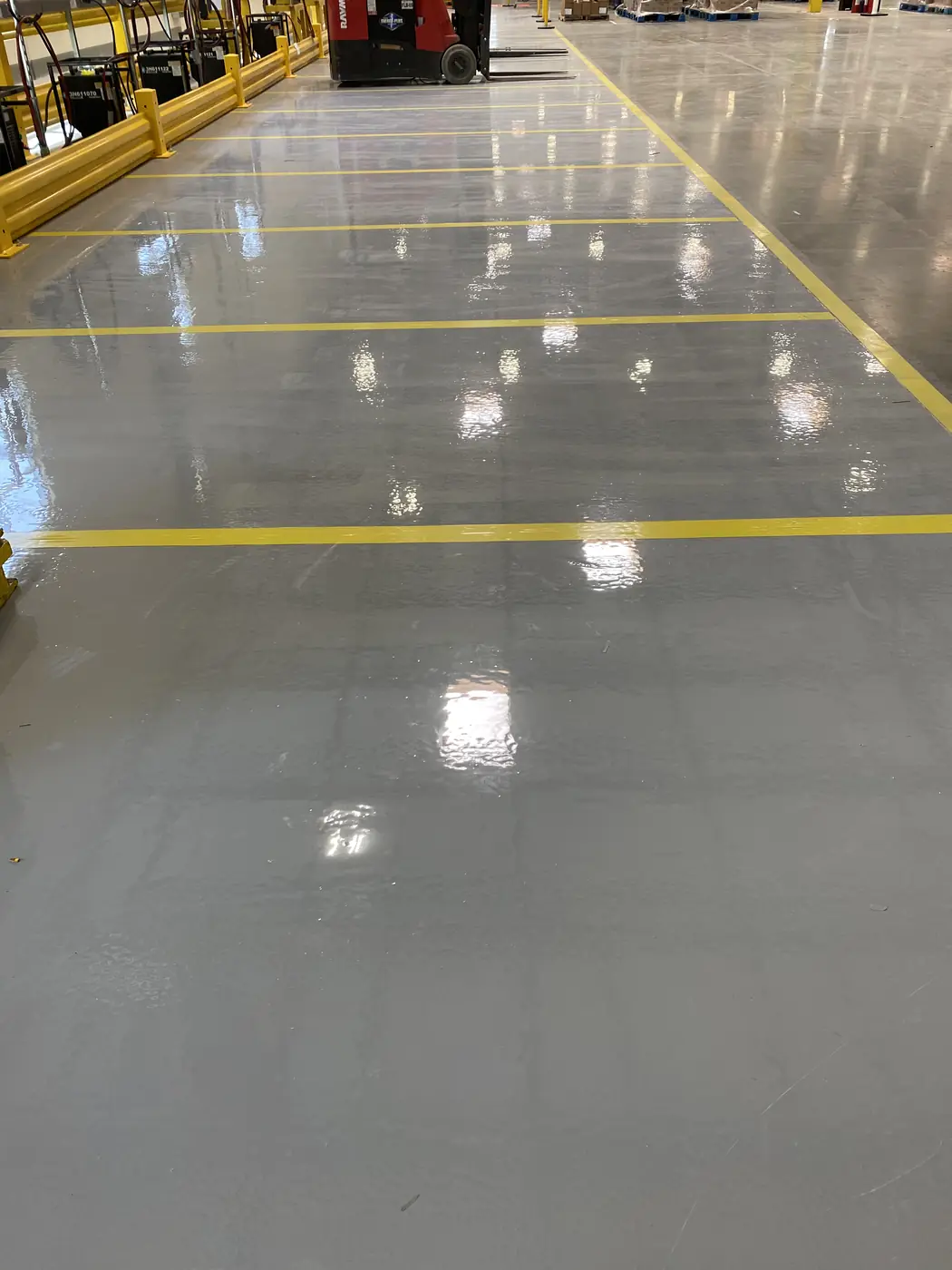
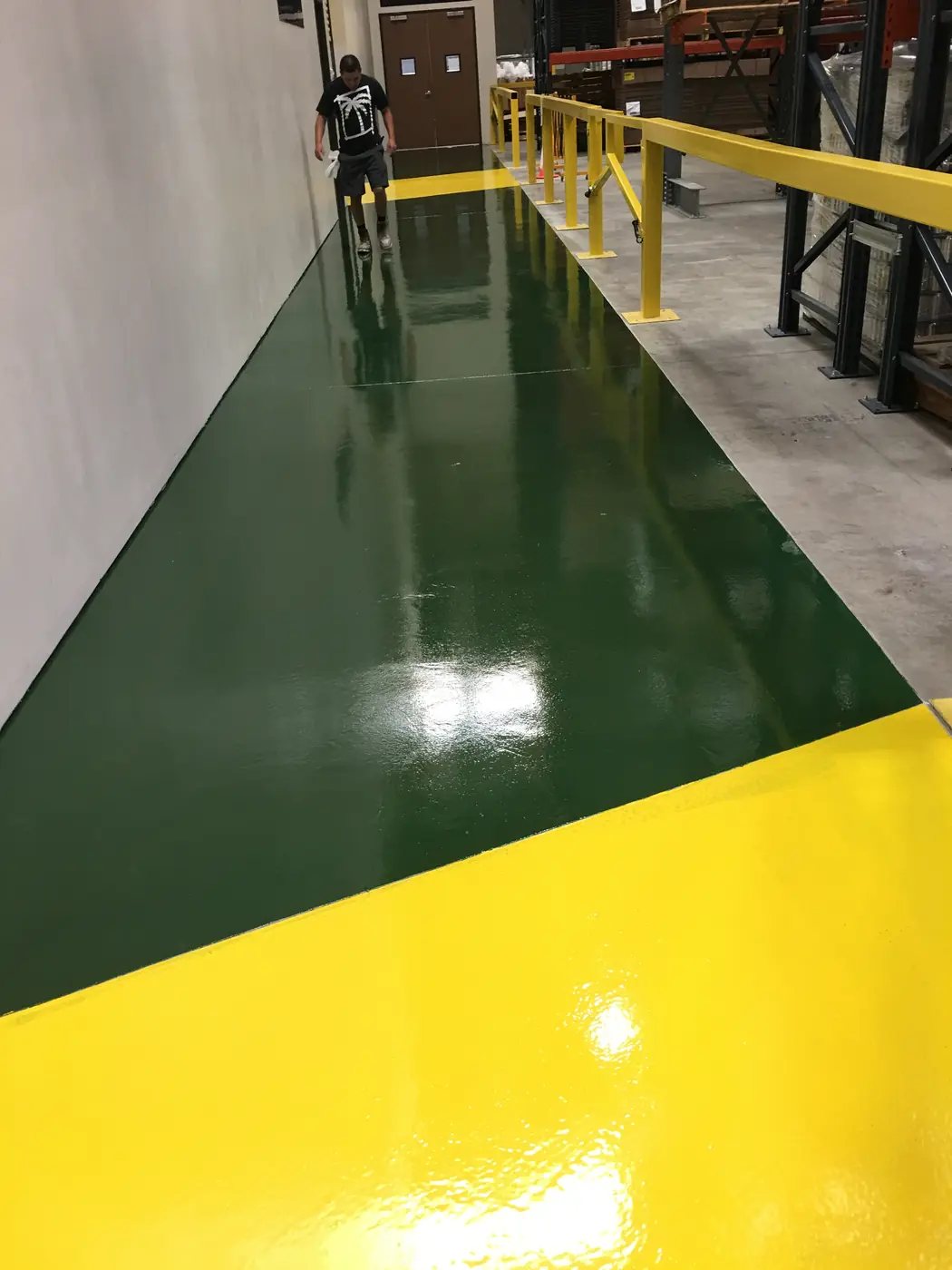
Striping and markings. Aisle lines, walkways, bay outlines and hazard zones go in as part of the coating system, not painted on afterwards. That is why they last as long as the floor instead of wearing off within the year, as we explained in how warehouse floor striping survives forklifts. It adds layout time, and it is worth it.
The five things that move a commercial quote
1. What is on the slab now
Bare, sound concrete is the cheapest starting point. A failed coating that has to be removed, or a floor with decades of oil in it, is not. Machine shop slabs can hold oil that keeps bleeding back after the grind, and some areas need a different approach or an accepted compromise. We would rather have that conversation at the estimate than watch a coating lift over the press pit six months later.
2. Whether the building can close
An empty building is the cheapest floor to do. A working one has to be phased: sectioned into bays or aisles, worked in an agreed order, often on nights and weekends. It takes longer and costs more than an empty building, and we will say so plainly. It is still far cheaper than stopping production.
3. The system specification
A storeroom and a forklift aisle do not want the same floor. Specifying one standard system across a whole plant either overpays in the quiet areas or underbuilds in the hard ones. The first conversation on the estimate is about the process, not the product: where the traffic runs, what gets spilled, what gets dropped.
4. Area and layout
Per square foot, big floors are cheaper than small ones, because the fixed cost of mobilizing a crew and grinding equipment spreads further. Cove bases, trench drains, columns, equipment that cannot be moved and a floor broken into many rooms all add time.
5. Moisture and slab condition
A slab giving up moisture from underneath will lift any coating regardless of how well it was bonded on top. It is more common than owners expect on older buildings and on slabs poured without a vapor barrier. We test for it, and where it is present a moisture-mitigating primer is part of the system rather than an extra we find later.
Reading a cheap quote
When one quote comes in well under the others, the difference is almost always in the preparation. Ask three questions.
- How is the slab prepared? The only acceptable answers are mechanical grinding or shot blasting. Acid etching on a commercial floor is not preparation.
- What is the total dry film thickness of the system, and what is the topcoat? A single thin coat priced against a multi-layer build is not a like-for-like comparison.
- Who does the work? Our own crews do the removal, the preparation and the finish. Nothing is subcontracted, which is the only way to keep the standard consistent from the first grind to the last stripe.
Is polished concrete cheaper?
Sometimes, and it is worth asking. Polishing is the slab itself ground and densified rather than a film laid over it, so there is nothing to peel. For retail floors, showrooms and warehouses where chemical resistance is not the issue, it can come in at a similar cost with a longer life. It depends on the hardness and condition of the concrete, and we will tell you if yours will not take a good polish before you spend money on it. Our polished concrete page covers the process.
Get a real number for your floor
The only way to price a commercial floor properly is to walk it. Dave will look at the slab, ask how the floor is used, and give you a number for your building rather than a rate you have to guess inside. We have been coating and preparing industrial concrete across Southern California since 1976, and the work carries five years on material and one year on labor.
Read more about our epoxy floor coatings and industrial floor coatings, or book a free on-site estimate.