A distribution manager in Moreno Valley asked us last year why the aisle lines his previous contractor put down had gone patchy in under six months, when the floor coating underneath still looked new.
The answer was in the order the work was done.
Striping on top versus striping underneath
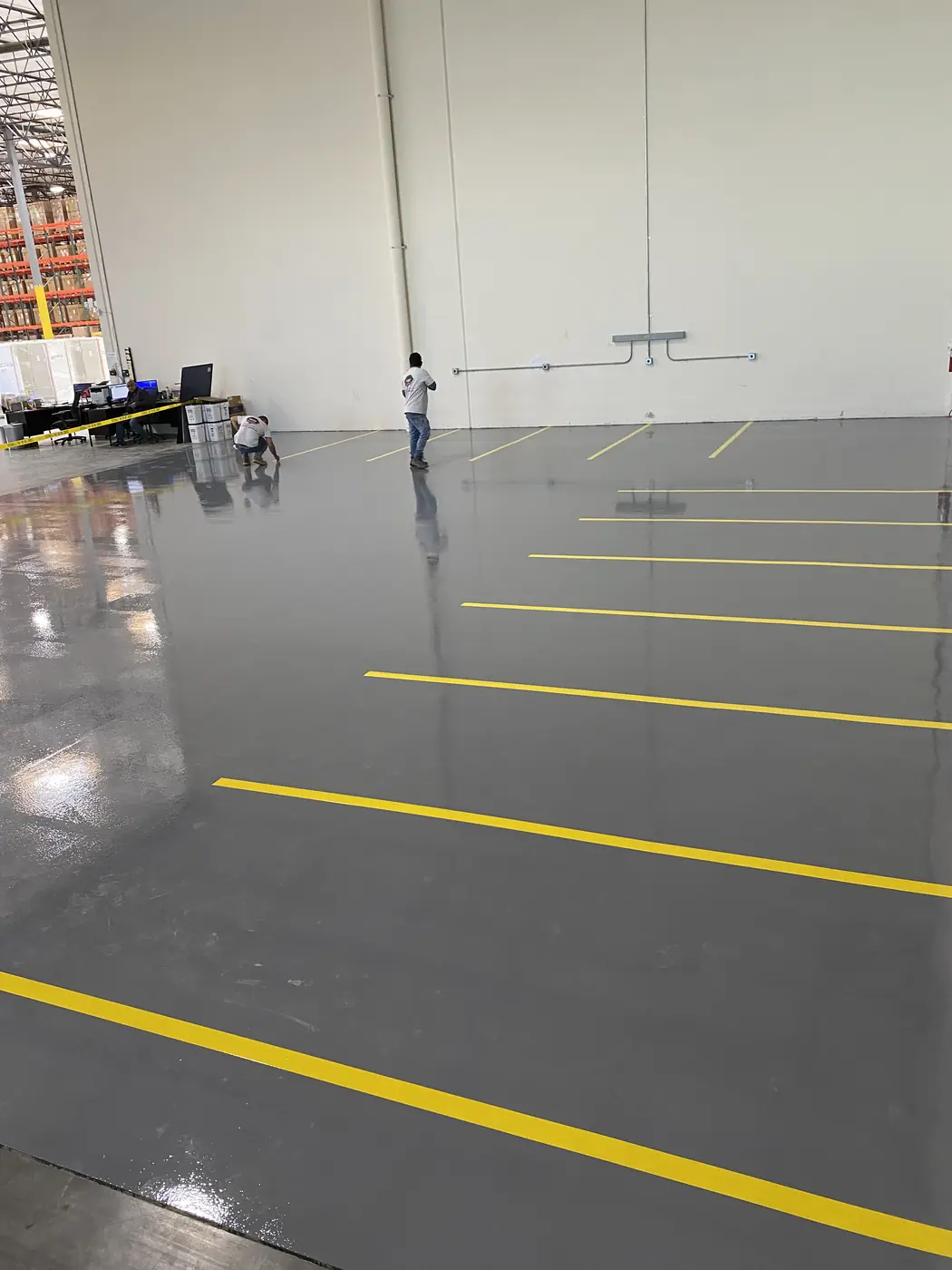
Most floor markings fail because they were painted onto a finished floor. The line sits proud of the surface, exposed, and every forklift wheel that crosses it abrades it directly. In a busy aisle that is thousands of crossings a week concentrated on a four-inch strip.
The durable method reverses it:
1. Grind and repair the slab 2. Lay the base coat 3. Lay the striping and any zone markings 4. Lay a clear wear coat over the whole floor, striping included
Now the traffic runs on the wear coat. The line is protected underneath it. When the floor eventually needs attention it is the wear coat that has worn — which is what it is there for — and the markings are still intact underneath.
It costs more up front because it is an extra coat over the whole floor rather than a small amount of paint on a fraction of it. Over the life of the floor it is considerably cheaper.
Getting the layout right the first time
Markings are expensive to move once they are under a wear coat, so the layout conversation happens before anything is laid:
- Traffic aisles and pedestrian walkways, clearly separated
- Racking footprints and staging areas
- Equipment exclusion zones, charging bays and eyewash stations
- Fire equipment and exit routes to whatever standard your site works to
- Any color convention your operation already uses across sites
We mark it out and walk it with your operations people before a drop of resin goes down. It is much cheaper to move a line with chalk than with a grinder.
Working around a building that cannot stop
Almost every warehouse we coat is live. Moreno Valley, Fontana, Ontario, Rialto and the Mira Loma corridor in Jurupa Valley are full of buildings running six or seven days a week, and shutting them down is not on the table.
How we handle it:
- The floor is sectioned and we agree the sequence in writing before we start
- We work nights and weekends where the schedule needs it
- There is always an agreed route through the building — you know exactly which part is out and when it comes back
- Cure times are stated as dates, not as "should be fine by Monday"
The thing that actually derails these jobs is not the coating, it is when a section is not cleared on the day it was supposed to be. We would rather over-communicate about that than lose a night.
Point loads and truck yards
One warning that applies particularly in Fontana and the distribution belt: trailer landing gear.
A parked trailer concentrates enormous load onto a few square inches of surface. Coatings that are entirely adequate for forklift traffic inside the building will punch through under it. In drive lanes a coating is usually fine. Where trailers drop their gear, frequently it is not, and the honest recommendation is repaired and sealed concrete rather than a coating that will fail in a year.
We would rather tell you that at the estimate than take the money for the whole yard.
Chemical exposure changes the specification
A general-purpose warehouse floor and a floor in a plant handling solvents are different products. So is a floor in a commercial kitchen, a brewery or a food processing area — those need chemical resistance, coving up the wall so there is no joint at the floor edge, and enough fall to actually drain.
There is a concentration of breweries and small manufacturing in the Vista business park and we have specified a number of those. The specification conversation has to come before the price conversation, because quoting a standard epoxy into a caustic wash-down environment produces a number that looks great and a floor that fails in eighteen months.
Is epoxy always the answer?
No. Where a warehouse does not need heavy marking, polished concrete is often the better long-term value — the slab is already there, there is nothing on top to fail, and it takes trolley and foot traffic extremely well. We go through that trade-off in polished concrete vs epoxy.
Scale
We have been preparing and coating industrial concrete since 1976 and have done millions of square feet of it, starting with tennis courts and moving into commercial floors. Large distribution floors are within normal range for us.
Tell us the square footage and the shutdown window and we will tell you honestly whether the timeline works before you commit to it. Book a free on-site estimate.