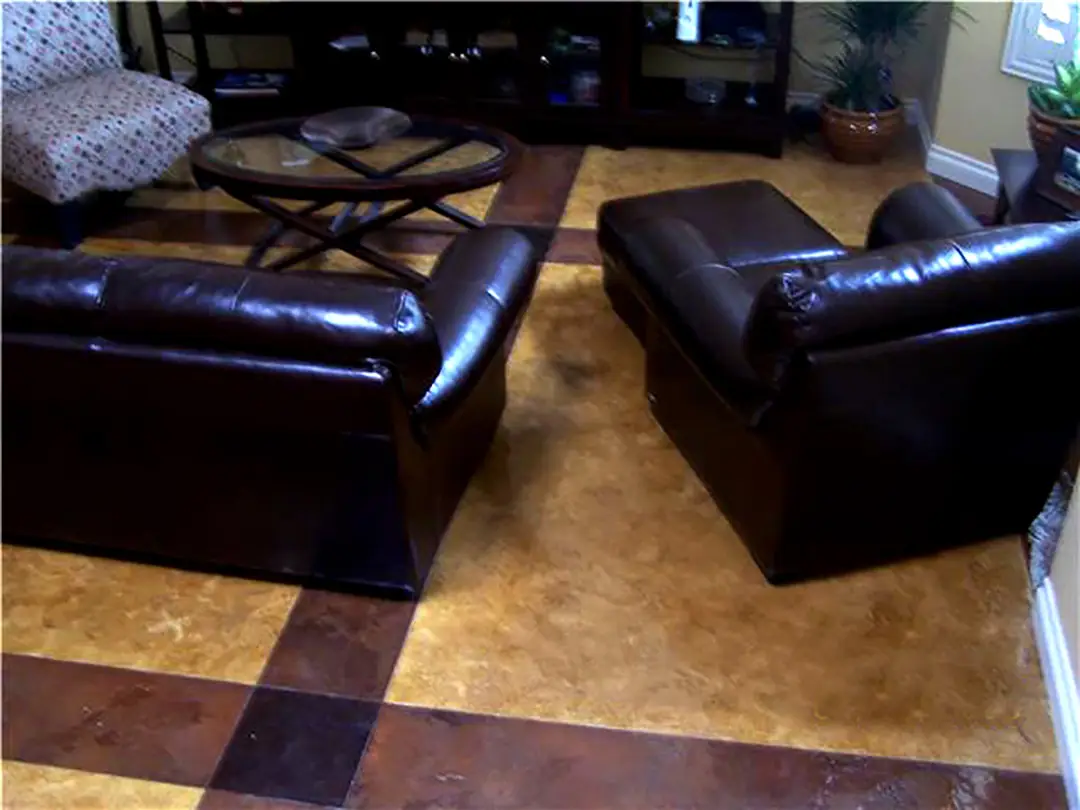
Pull back a corner of carpet in most Southern California houses and you will find a concrete slab. That slab is not just what the floor sits on. Ground, stained and sealed, it can be the floor.
The question we get asked most is some version of this: my slab has been under carpet for twenty-five years, is it good enough to stain? Usually it is. But stain is not paint. It is translucent, and it shows the slab it goes into. Knowing what is likely to be under your flooring, and what can be done about it, is the difference between a floor you love and a surprise.
What is usually under there
A slab that was always going to be covered was never finished to be looked at. The builder knew carpet or tile was going over it, and everyone on site treated it that way. What we find depends on what was laid on top.
- Under carpet: tack strip around the edge of every room, nailed into the slab every few inches. When it comes up it leaves a line of small craters. There is often paint overspray, drywall mud and the odd footprint from the original build as well
- Under tile: a layer of thinset mortar bonded to the slab, which has to be ground off. Sometimes the grid of the old tile layout stays faintly visible in the concrete afterwards
- Under vinyl, laminate or glued-down wood: adhesive, and sometimes several generations of it. Old black adhesive in an older house needs testing for asbestos before anyone grinds it. We covered that in how old coatings come off concrete
None of this is a reason not to stain. All of it has to be dealt with before the color goes down, because stain only shows what the slab lets it. Glue residue, old sealer, patches and trowel burns all read through.
What stain hides and what it does not
This is the honest part of the conversation, and it is better had before the carpet comes up than after.
Stain does not hide cracks. Nearly every slab has a few hairline shrinkage cracks. On a stained floor they stay visible and tend to take the color a little darker. Most people come to like them. They are a large part of why a stained floor reads as stone rather than as a manufactured surface.
Patches stay visible. The tack strip holes get filled, and so do any chips and divots. But patching material is not the same as the concrete around it, and it takes stain differently. A filled hole is a small dot of a slightly different shade. Around the edge of a room, a row of them can show as a dotted line.
Old layouts can ghost. Where glue or thinset sat for decades, the concrete underneath has sometimes aged differently from the concrete beside it. Grinding removes most of that. Occasionally a faint pattern survives.
An acid stain is the more forgiving of the two types here, because its natural mottling gives the eye plenty of variation to look at. A water-based stain is more even, which makes it less forgiving of what is underneath. We compared the two in acid stain vs water-based stain.
Working with an imperfect slab
A slab does not have to be perfect to make a good stained floor. There are three tools for working with what is there.
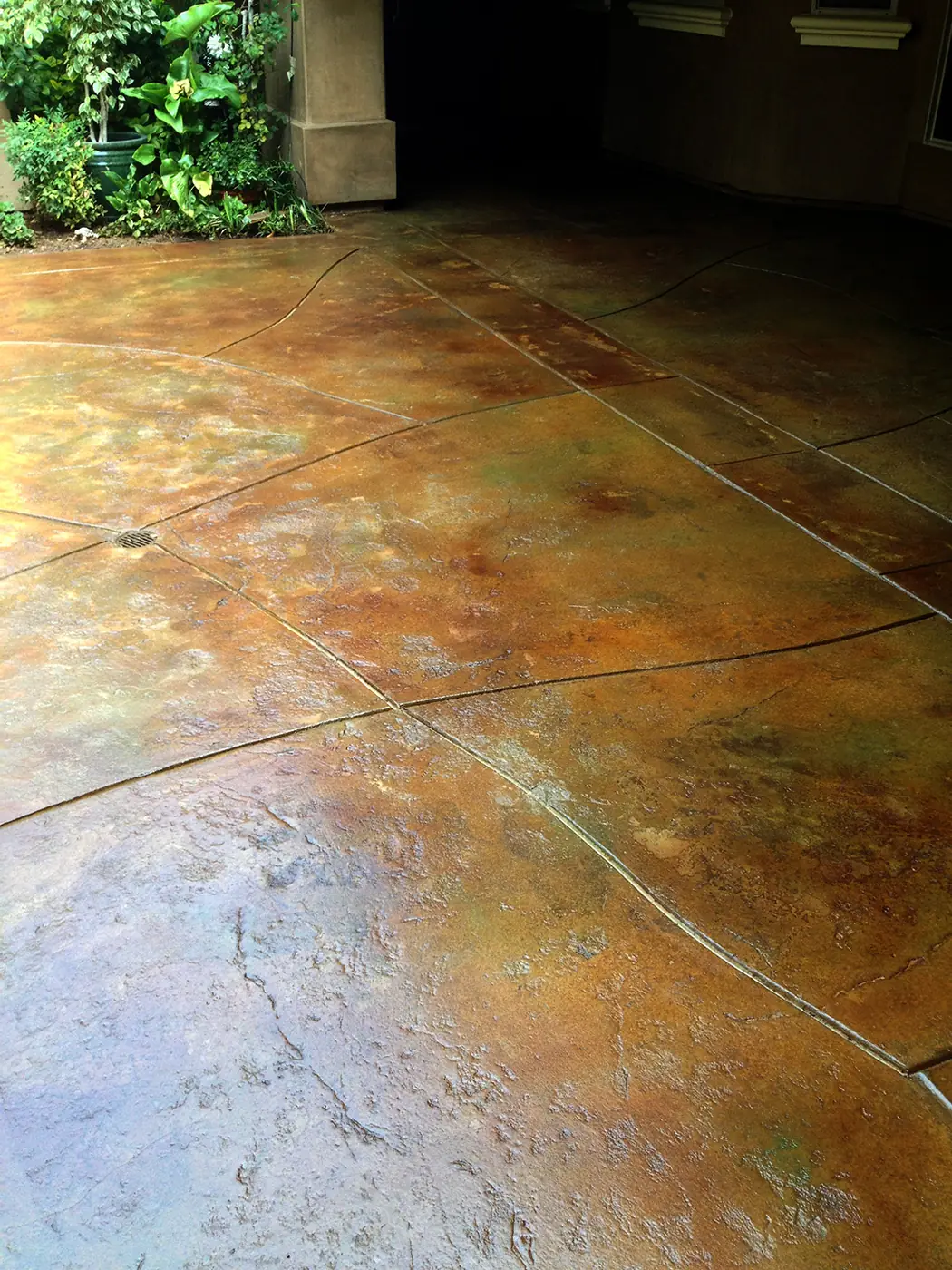
Scored patterns and borders. We cut tile, diamond, plank and border patterns into the slab before staining, and the sections can be stained in different colors. A dark border band around a room, like the one in the photo above, is a design choice. It also happens to sit exactly where the tack strip holes were. A score line can be laid along a crack so that it reads as part of the pattern.
Color choice. Deeper, more varied tones carry flaws better than pale, even ones. We lay a sample of the stain on your own slab before the whole floor is committed, so you see how your concrete takes it, flaws included, rather than judging from a chart. The range is on our colors page.
A new surface. If the slab is too far gone to look good stained, with heavy patching, deep contamination or damage across the room, the answer is a thin overlay that gives a fresh, uniform surface to stain. That is microtopping, and it is a different job with a different price, so you hear about it at the estimate and not halfway through.
How the job runs
Every step is done by our own crews. Nothing is subcontracted.
- Removal. The carpet, tile or laminate comes up, along with the tack strip, glue and any old coating. We do this ourselves, so nobody is guessing about the condition the slab will be handed over in
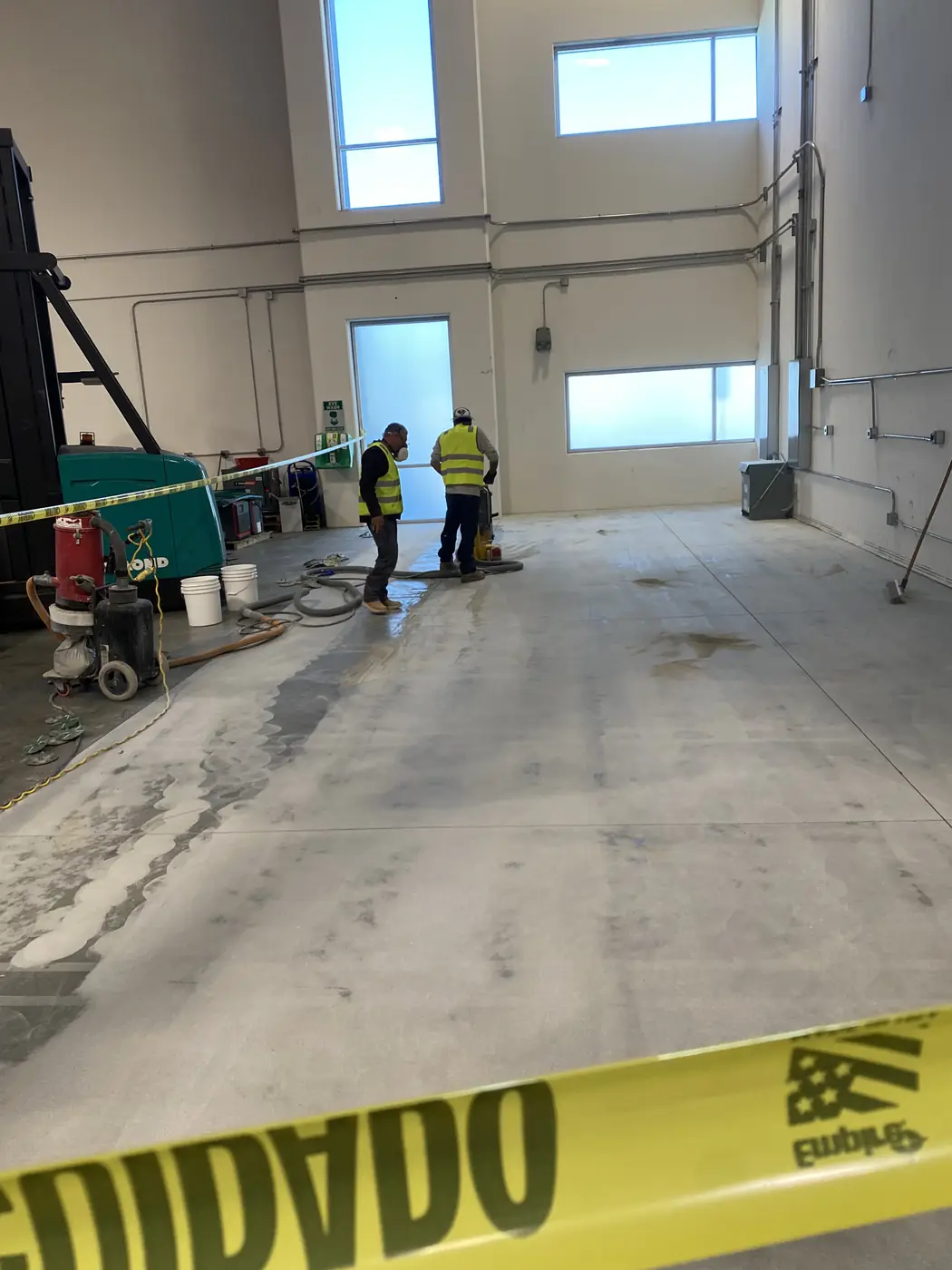
- Grinding. The whole floor is ground with diamond tooling and vacuum extraction. This takes off residue and sealer and opens the surface so the stain takes evenly
- Repair. Holes, chips and any cracks that need it are filled
- Sample. A test area is stained on your slab so the color is agreed on the real thing
- Scoring. Any pattern, border or layout is cut into the floor
- Staining. One color or several, blended or kept to their own sections
- Sealing. The floor is sealed to the gloss you want, from satin to a full reflection
The rooms need to be empty while this happens, and the floor needs time to cure before furniture goes back. How long depends on the size of the job and the system, and you get real dates on the estimate rather than a brochure figure.
What we check before quoting
What is under the flooring decides the final look, so we check it before we quote. Where we can, that means lifting a corner of carpet or looking inside a closet, where the slab is usually at its most honest. We are looking at how hard and how clean the concrete is, what adhesives are down, how much cracking and patching there is, and whether there is any sign of moisture coming up through the slab, which affects which sealer goes on top. Moisture is mainly a concern nearer the coast, for the reasons in why coastal garage floors keep failing.
If the slab will not make a good stained floor, we will tell you that before you spend money on it.
Living with it
A stained slab has nothing to scratch through, nothing for pets to ruin, and it stays cool underfoot through an inland summer. The color is in the concrete, so it does not peel or chip. The sealer on top is what takes the wear, and it can be recoated in a day without redoing the floor. Day-to-day care is a dust mop and a damp mop. The details are in how to clean and look after a finished concrete floor.
Getting it quoted
We have been preparing and finishing concrete since 1976, and interior staining is one of the oldest lines of work we have. There are living rooms, kitchens, hallways and entries in our gallery, and the detail is on our interior concrete staining page. If you are thinking about taking up old flooring, book a free on-site estimate first and we will tell you what your slab is likely to give you.