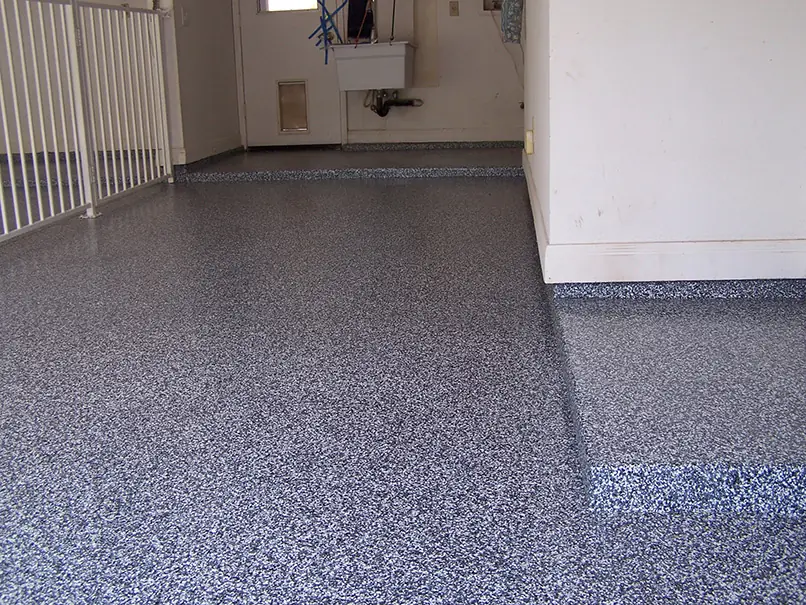
If you live in Carlsbad, Oceanside, Point Loma or the older western side of Chula Vista and your garage floor coating has lifted, there is a good chance the coating was fine, the preparation was fine, and it still failed.
The culprit is underneath the slab.
Moisture vapour transmission
Concrete does not stop water, it slows it. Groundwater near the coast keeps slabs damp from below, and that moisture does not stay liquid — it moves up through the concrete as vapour and evaporates off the top surface. On a bare slab you would never notice. It leaves and you get on with your day.
Now put a non-breathable coating on top. The vapour still arrives, but it cannot escape. It collects at the bond line between the concrete and the coating, and it builds pressure. Eventually the pressure exceeds the strength of the bond and the coating comes off — not in flakes, but in large sheets, sometimes with a thin layer of concrete still attached to the back of it.
The tell is the timing. Kit failures and preparation failures usually show up within months, often where the tires sit. Moisture failures typically appear around the one-year mark and are not concentrated where the traffic is. If your coating came off in a broad sheet away from the tire tracks, this is very likely what happened.
Why it is a coastal problem
It is not exclusively coastal — a slab poured without a vapour barrier will do it anywhere, and so will one over a high water table. But near the ocean you have consistently high groundwater and consistently high humidity, so the drive is stronger and more constant.
We see it in:
- Older properties where slabs were poured before vapour barriers were standard practice
- Anywhere the slab sits low relative to surrounding ground
- Garages and interior rooms on the seaward side of a property
- Buildings where landscape irrigation runs right up against the slab
Inland, in Riverside or Hemet, we test for it far less often and the readings are usually low. In Carlsbad and Oceanside we test as a matter of course before quoting an interior floor.
How it is tested
There are standard methods — relative humidity probes set into the slab, and calcium chloride tests that measure how much moisture comes off a given area over a set period. Neither is expensive, and neither is something you can judge by looking at the floor or by touching it. A slab with a serious vapour drive can look and feel bone dry.
The test costs a small fraction of doing the floor twice.
What fixes it
Not a thicker topcoat. That is the instinctive response and it makes the problem worse, because a thicker film is a better barrier and traps more pressure.
The fix is a moisture-mitigating primer — a system designed to bond to a damp slab and either tolerate or control the vapour drive before the finish coats go on. It is an extra material and an extra day, and on a slab with a high reading it is the difference between a floor that lasts and a floor you redo.
Where a coating is genuinely unsuitable, polished concrete is worth considering instead. Polishing refines the slab itself rather than putting a film on it, so there is nothing for vapour pressure to push off. On a coastal interior with a stubborn moisture problem it can be the more sensible long-term answer, and we will say so.
The other coastal problem: chloride
While we are on the subject of salt air, the outdoor version of this is corrosion. Airborne chloride works into concrete and attacks the reinforcement. The steel rusts, rust occupies more volume than steel, and the expansion breaks the concrete from the inside.
If you have a patio or a step with a spalled patch and rust showing in it, that is what is happening. Coating over it buys a season. The correct repair exposes the steel, treats it, rebuilds the section, and then coats. It costs more and it is the only version that lasts. Anyone offering to skim over visible rust is selling you a year.
Before you recoat
If a coastal floor has already failed once, recoating with the same system will get the same result. Test first. We cover San Diego County from Wildomar with no travel charge — book a free on-site estimate and we will tell you what your slab is actually doing.