Every new floor finish starts with the same question: what is on the concrete now, and how does it come off? A failing coating cannot be covered. Anything laid over it inherits the same bond failure and comes away with it. It has to come off, back to sound concrete with a profile the next system can grip.
Removal is a trade in itself. It is also the part of a flooring job most likely to go wrong when it is treated as an afterthought. The right method depends on the coating, its thickness, the slab, and whether the building stays open while the work happens.
Why the method matters
There is no single machine that takes everything off every floor. Use a tool that is too gentle on a thick system and a crew spends a week doing what should have taken two days. Use one that is too aggressive on a thin sealer and you tear up the surface of the slab, which then has to be repaired before anything new goes down.
The goal is not just bare concrete. It is bare concrete with the right surface profile, the texture the next coating needs to bond to. The industry grades that texture on the concrete surface profile scale published by the International Concrete Repair Institute, from nearly smooth up to very rough. A thin sealer wants a light profile; a thick overlay or a heavy-duty industrial system wants a much rougher one. Removal and profiling are usually the same step, so the method has to deliver both.
Diamond grinding
A grinder spins heads fitted with diamond tooling against the floor, cutting the coating and the top skin of the concrete away. It is the workhorse of coating removal.
- Good for: thin to moderate epoxy, paint, sealers, curing compounds and most garage floor coatings
- Leaves: a light to medium profile, easy to control and consistent right up to the walls with edge grinders
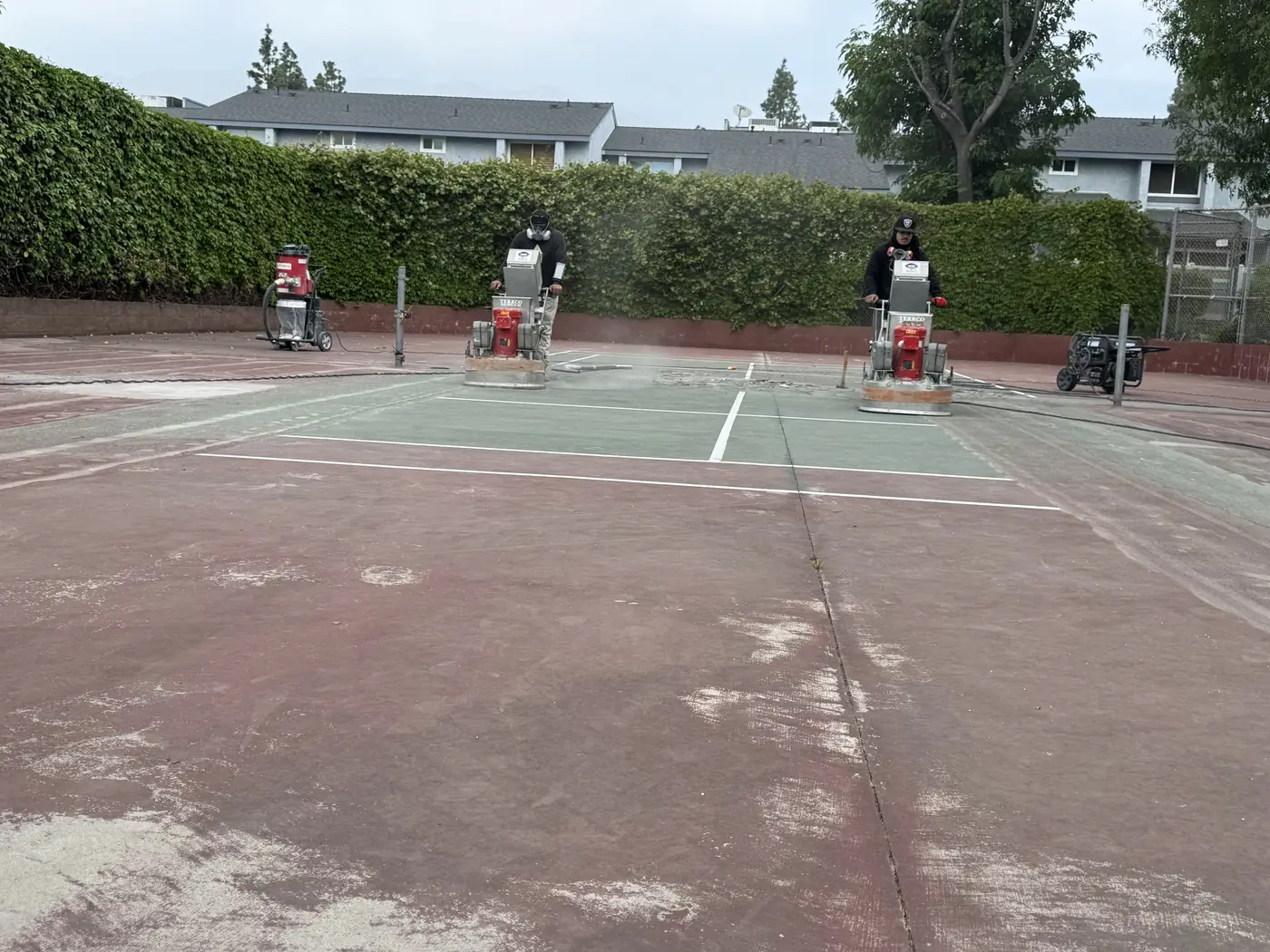
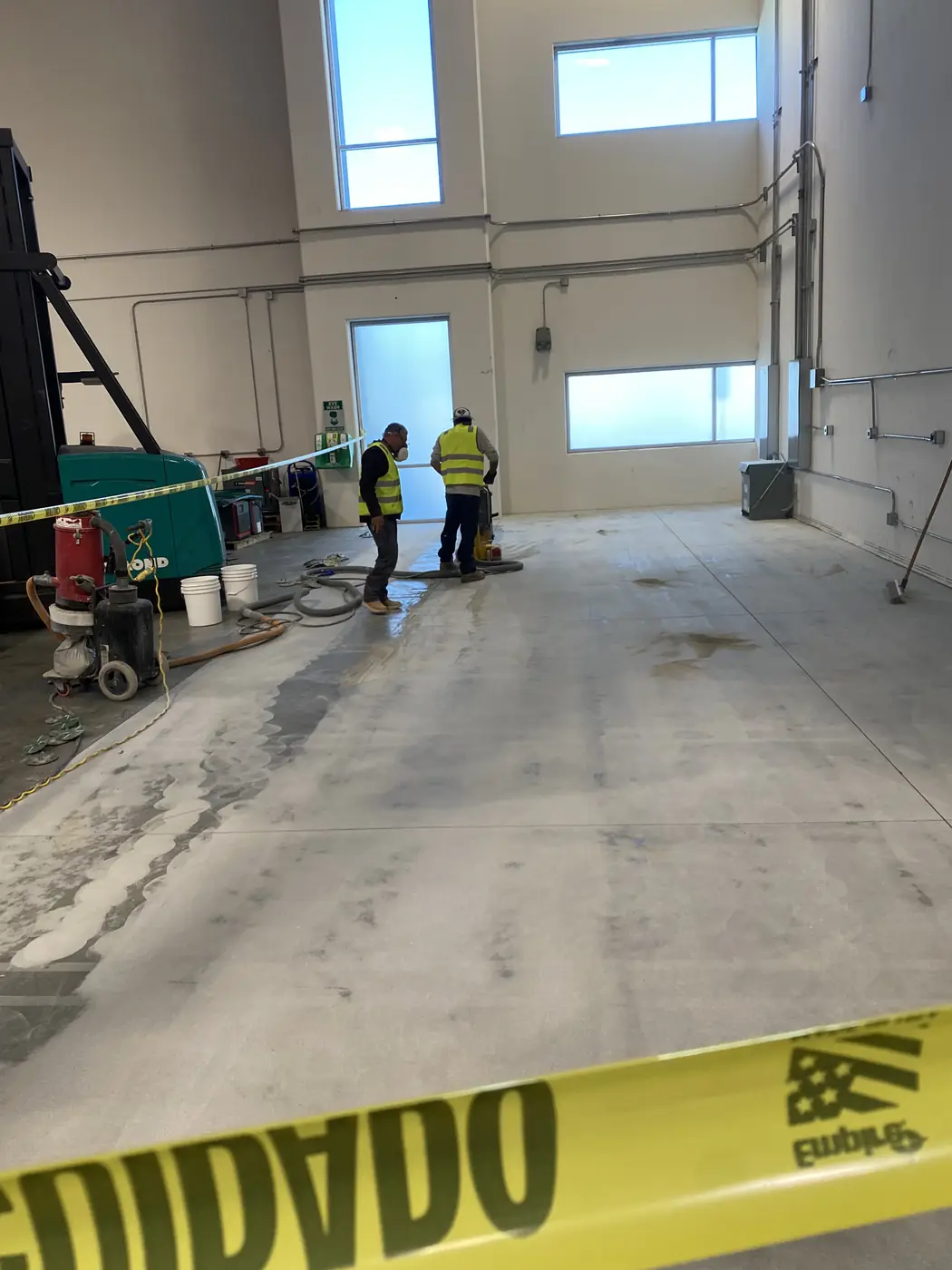
- Dust: run with vacuum extraction, as in the photo above, so it can be done indoors and in occupied buildings
Grinding is also how a slab gets prepared when there is no coating at all, which is why so many of our jobs start with it. Its limit is soft, gummy material. Thick elastomeric coatings and some adhesives melt under the heat of the diamonds and smear instead of cutting, loading the tooling and slowing the job to a crawl. That calls for different tooling or a different machine.
Shot blasting
A shot blaster fires small steel shot at the floor at high speed, knocks off the coating and the weak surface layer, and recycles the shot through a vacuum system that also collects the debris.
- Good for: large open areas, thin coatings and paint, and creating a uniform medium profile quickly
- Leaves: a textured, open surface that heavier coatings bond to very well
- Limits: it cannot reach tight to walls or into corners, so edges are finished with a grinder, and it struggles with thick or rubbery systems that absorb the impact
On a warehouse, a gym or a big commercial slab where the next system needs a strong profile, shot blasting is often the fastest route. The patterned lanes it can leave are something the next coating has to cover, so it is matched to what is going on top.
Scarifying
A scarifier, sometimes called a milling machine, drives rows of rotating cutter wheels into the floor. It chips rather than grinds, and it takes material off aggressively.
- Good for: thick coatings, heavy build-ups, old overlays, thick traffic markings, and lowering a high spot in the slab
- Leaves: a very rough, grooved surface that usually needs a pass with a grinder or a skim coat before a thin finish
- Limits: far too aggressive for thin sealers or for a slab that only needs a light profile
Scarifying earns its place on multi-layer systems that would take a grinder days. Court surfaces that have been recoated for decades are a good example; we discussed when a court reaches that point in when a tennis court needs stripping.
Mastic, thinset and other surprises
When old flooring comes up, what is left on the slab is often not a coating at all.
Thinset from ceramic tile is hard and brittle, and it grinds or scarifies off well once the tile is gone.
Carpet and vinyl adhesives are the gummy problem. They load up standard diamonds, so they need specialist tooling that scrapes rather than grinds, and sometimes several passes.
Old black mastic deserves a warning. Black cutback adhesive from older buildings can contain asbestos. It has to be tested before anyone grinds, blasts or scarifies it. If the test comes back positive, it is a job for a licensed abatement contractor before any floor preparation starts. Nobody should be making dust out of it on a guess.
The test patch
On a building that has changed hands, or a floor with layers from different decades, nobody knows exactly what is down. We test a small area first to see how it comes off before committing to a method across the whole floor. The wrong approach on an unknown coating wastes a day and sometimes damages the slab. The test patch is part of the estimate, not an extra.
The test also tells us what is underneath. Usually the concrete is in better shape than people expect. If it is not, if there is spalling, heavy contamination or a moisture problem, you hear about it from us the day we find it rather than after a new system has been laid over it. Moisture especially is worth knowing about early; see why coastal garage floors keep failing.
Occupied buildings
Removing a coating inside a working building is a dust-control problem more than a grinding problem. We run vacuum-assisted equipment and containment so a store, clinic or warehouse can keep operating around the work. It changes the schedule and the price, so tell us up front if the building stays open and we will scope the job that way.
Removal for other contractors
About half of our removal work is preparation for our own floor coatings. The other half is for flooring and coating contractors who need a floor stripped and do not own the equipment, or would rather not tie up a crew for a week doing it. We take the old system off, leave the slab profiled to the spec they need, and they lay their own finish over it. No competition on the finish work. We are there for the removal.
If you are budgeting a commercial floor, removal is often the line that surprises people. Commercial epoxy flooring cost per square foot shows where it fits in the total.
Getting it quoted
We have been stripping and preparing concrete since 1976, starting on tennis courts, and we do it with our own equipment and our own crews. Details are on our concrete coating removal page. Whether it is a garage, a commercial space or a floor you need handed back ready for your own finish, book a free on-site estimate and we will look at what is down and tell you how it should come off.