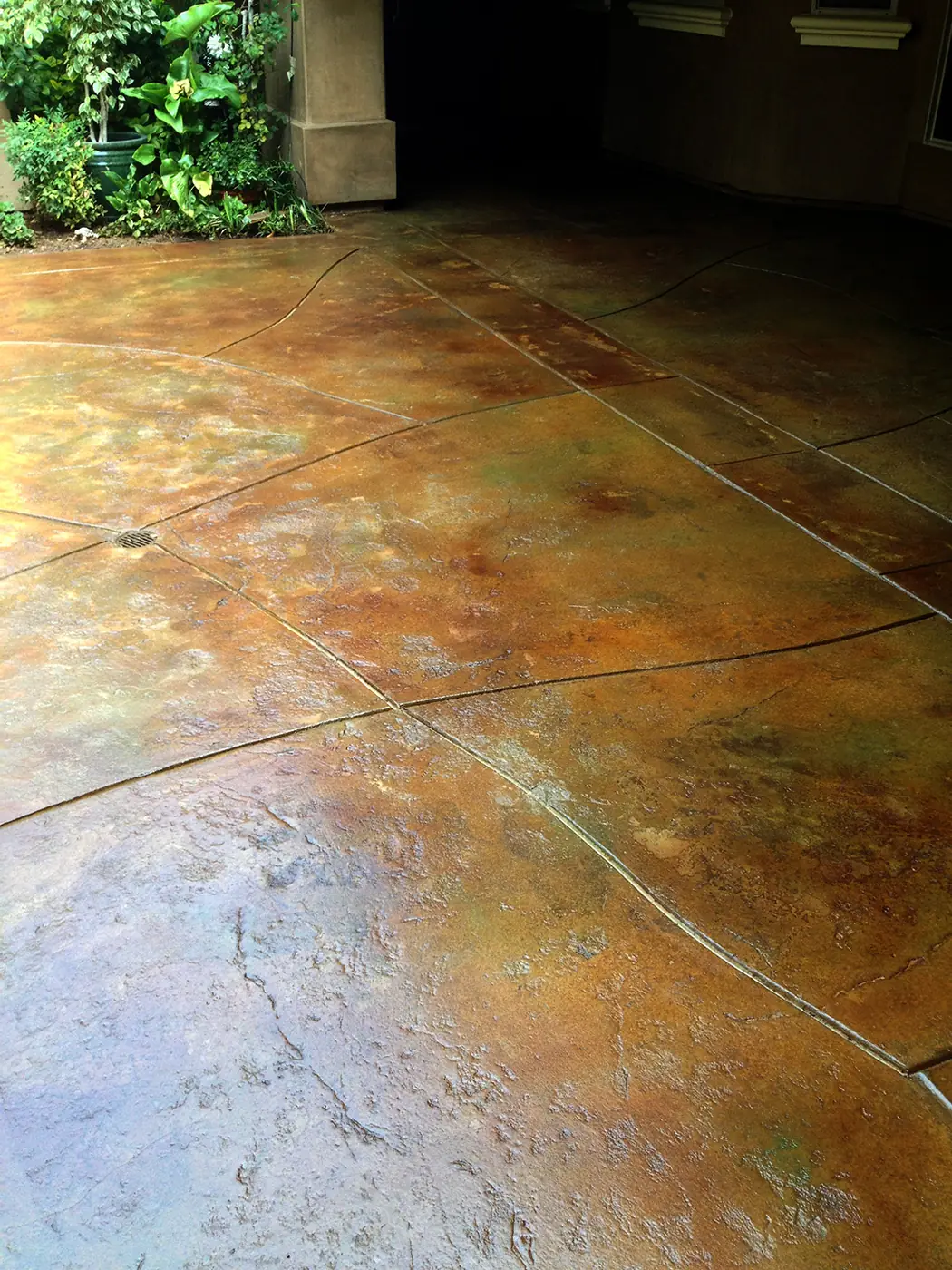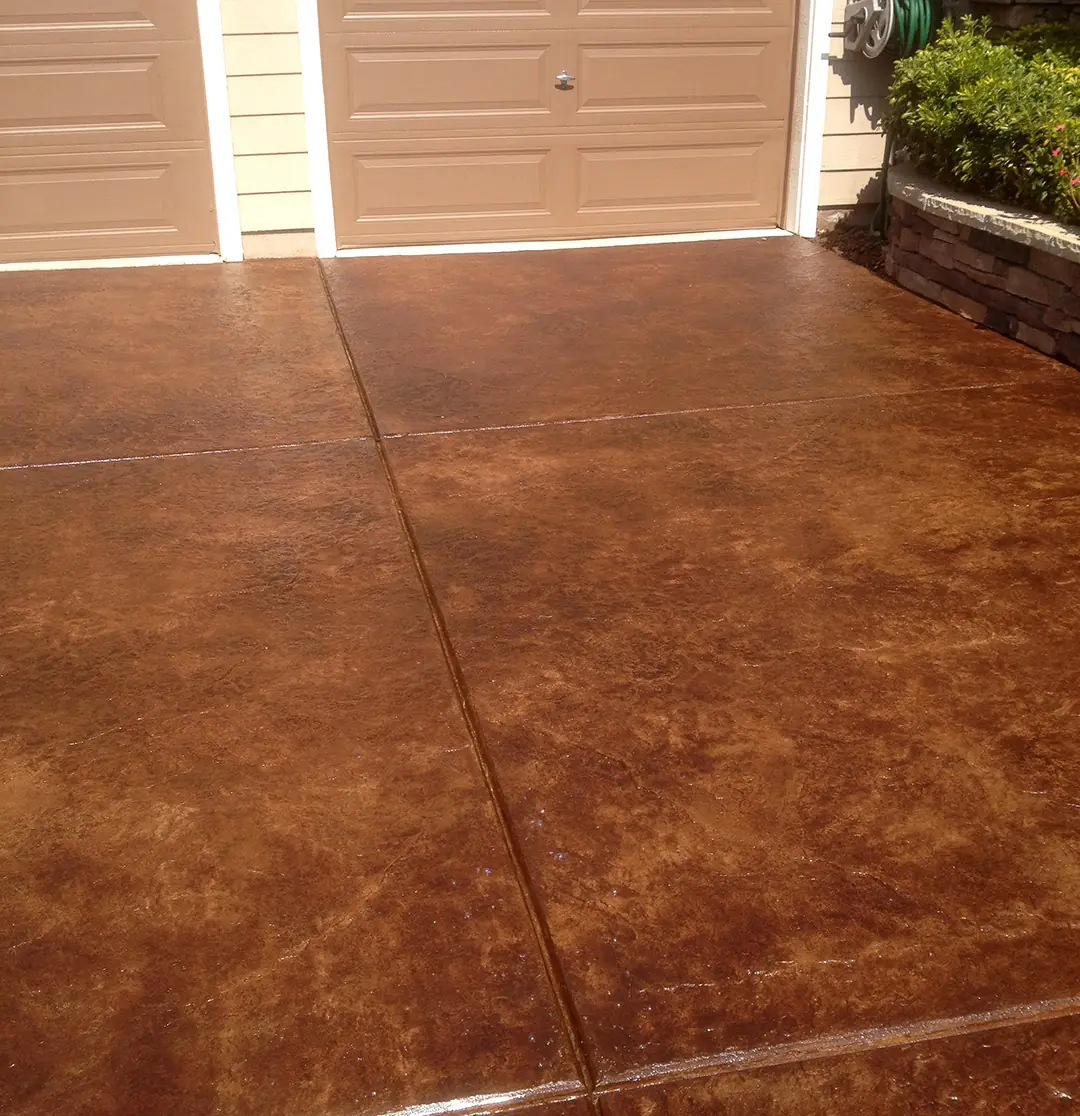
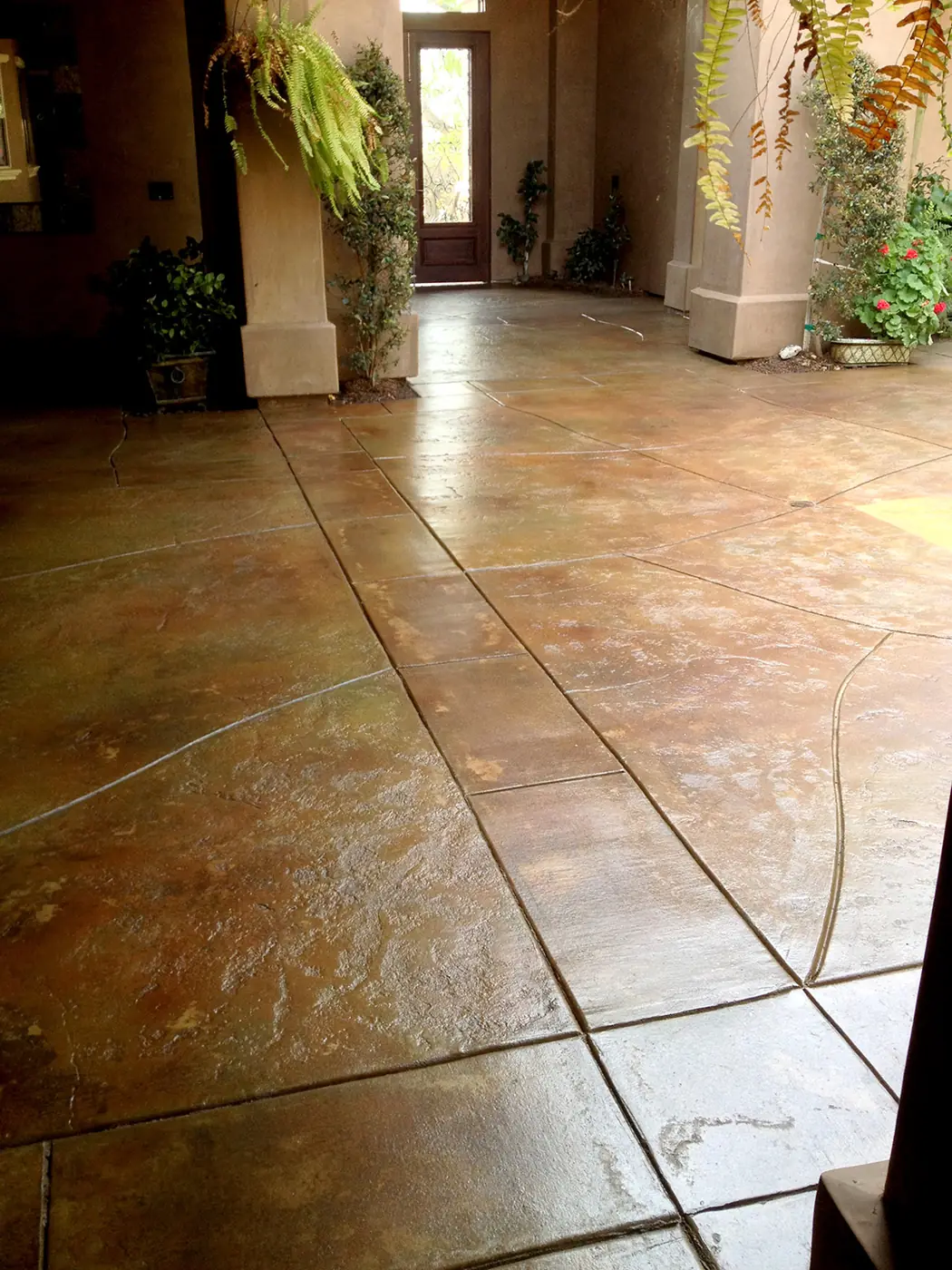
A stained patio or driveway gets its color from the stain, but its looks from the sealer. The sealer is what gives the deep, slightly wet look in the photo above, and it is what protects the color from sun, sprinklers and tires. So when a sealed slab goes white, milky or cloudy, the concrete underneath is usually fine. Something has gone wrong in, under or on the sealer.
There are several different problems that all look like "it went white", and they have different fixes. Working out which one you have is most of the job.
Milky patches inside the sealer
What it looks like: a milky or foggy haze that is in the sealer itself. It does not wipe off, and it often shows up after rain, a sprinkler cycle or a cool, damp night.
What it is: moisture trapped in the sealer film. It is most common with solvent-based acrylic sealers and is often called blushing. It tends to happen when sealer goes on over concrete that was still damp, in humid or cool conditions, or too close to the sprinklers coming on. Moisture coming up from underneath can cause it too.
What fixes it: sometimes nothing. Mild blushing can clear by itself as the film dries out in warm weather. Solvent-based acrylics can often be re-wet with the right solvent so the film softens and releases the trapped moisture, but that depends on knowing what sealer is on the slab, and it is not something to experiment with using whatever is in the garage. If it keeps coming back, the moisture source has to be found first.
White, hazy build-up that is starting to flake
What it looks like: a general white or gray haze, often worst in low spots and along edges, with the sealer beginning to peel or flake in places.
What it is: too much sealer. Every reseal adds another layer, and after enough of them the film is thick enough to trap moisture and stop the slab breathing. The same thing happens when sealer is flooded on too heavily in one go and puddles. The more that is on there, the worse it gets.
What fixes it: taking some or all of it off and going back with thin coats. Adding another coat over a thick, cloudy film makes the problem thicker. Where the old sealer has built up badly or is peeling, it has to be stripped before resealing, and that is removal work rather than a cleaning job.
White powder on the surface
What it looks like: a chalky white powder or crust on the surface that brushes off when it is dry, and comes back after the next wet spell. It is often worst near planters, lawns, downspouts and the low side of the slab.
What it is: efflorescence. Water moving up through the concrete carries dissolved salts with it, and when the water evaporates at the surface the salts are left behind. It is a water problem that shows up on the concrete, not a sealer problem, though it can get trapped under a sealer and whiten it from below.
What fixes it: dealing with the water. Sprinklers aimed at the slab, planters draining onto it and a yard that grades toward the concrete are the usual sources, and until they change the salts will keep coming. The deposits themselves can be cleaned off, and in most cases the slab can be resealed once it has dried out properly.
White where the sealer has lifted
What it looks like: white or silvery patches with edges, where the sealer has let go of the concrete and air has got under it. Scratch the edge and it comes up.
What it is: a bond failure. Sealer applied over dirt, over an old and incompatible sealer, or over a slab that was never properly cleaned has nothing to hold onto. Sun and moisture do the rest.
What fixes it: the loose sealer has to come off. There is no way to glue a lifting sealer back down, and a new coat over it will lift with it. Once the slab is clean and back to a sound surface, it can be resealed.
Cloudy marks under mats and pots
A cloudy patch exactly the shape of a doormat, a rubber-backed rug or a planter is moisture trapped against the sealer by whatever was sitting on it. Moving the item and letting the area dry out in the sun often clears it. The care side of this, indoors and out, is covered in how to clean coated concrete floors.
Telling them apart
A few simple checks narrow it down:
- Does it brush off when dry? A powder that brushes off and comes back after watering is efflorescence
- Is it in the film? A milky haze you cannot wipe off, that appears after wet weather, is moisture in the sealer
- Does it have edges you can lift? That is sealer that has lost its bond
- Is it worst where sealer is thickest? Low spots, edges and puddle marks point to too much sealer
Some slabs have more than one of these at once. An old driveway can have years of built-up sealer with efflorescence trapped under it, and that is the case where a proper look is worth more than a guess.
Keeping it from happening
Most of these problems are set up on the day the sealer goes down:
- Seal a dry slab. The concrete should be properly dry, not just dry on top after a morning of sun
- Watch the weather and the sprinklers. Avoid sealing late in the day before a cool, damp night, and turn the sprinklers off until the sealer has cured
- Go thin. Thin coats that can dry out are better than one heavy coat, and far better than a new coat over an old thick one
- Fix the water first. If efflorescence has been a problem, the source needs dealing with before any sealer goes on
When it is time to reseal
On stained exterior concrete, a sealer that is doing its job makes water bead or darken the surface only slightly. When the color starts to look dull and dry, and water soaks in and darkens the slab straight away, the sealer is worn and the color is losing its protection. Resealing at that point is a quick job. Leaving it until the color itself has weathered makes it a bigger one.
What we do
Sealing is part of every stain job we do rather than an extra, because the seal is what holds the color against sun and traffic. The same preparation that makes a stain take evenly is what makes a sealer bond. Where old sealer or an old coating has built up or failed, taking it off properly is work our own crews do, and it is covered in more detail in how old floor coatings are removed.
If the slab has gone past resealing, with the color gone or the surface worn out, it can be restained or given a new surface. The options are on our exterior concrete staining and microtopping and overlays pages, and the difference between stain types is in acid stain vs water-based stain. Book a free on-site estimate and we will tell you which kind of white you have, and what it actually needs.