Most people who call us about an ugly patio assume the answer is a jackhammer and a new pour. It almost never is. Outside concrete rarely goes bad. It gets ugly: cracked, stained, patched in three shades of gray, and worn smooth where everyone walks.
The structure underneath is usually fine. What needs replacing is the surface, and a surface can be replaced without touching the slab. That is what a concrete overlay does.
What an overlay actually is
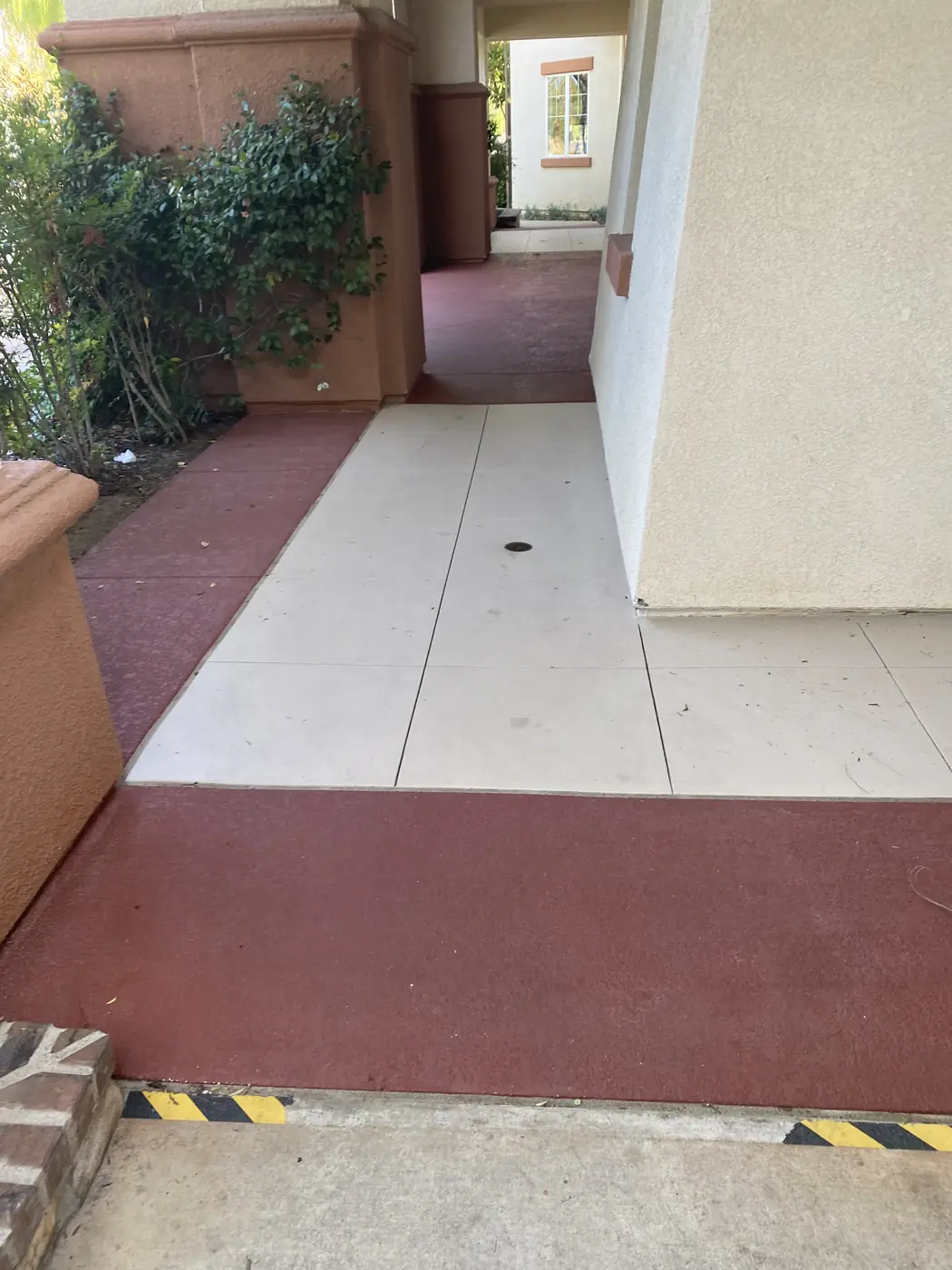
An overlay, or microtopping, is a thin cementitious layer bonded directly over the concrete you already have. It goes down in coats, a few millimeters thick in total, and while it is still workable it can be textured, patterned and colored.
Because it is so thin, it does not raise the level of the patio enough to cause problems at door thresholds, pool coping or where the patio meets the lawn. And because nothing is demolished, there is no concrete to haul away, no forms, no weeks waiting for a new pour to cure, and none of the damage to planting, sprinklers and walls that comes with breaking out a slab.
The system we use is Dexite, an overlay built specifically to take patterns. That matters: an overlay designed only to be smooth and gray will not hold a crisp flagstone joint or a cobblestone edge the way a patterning system does.
The patterns you can have
The range runs from simple to elaborate:
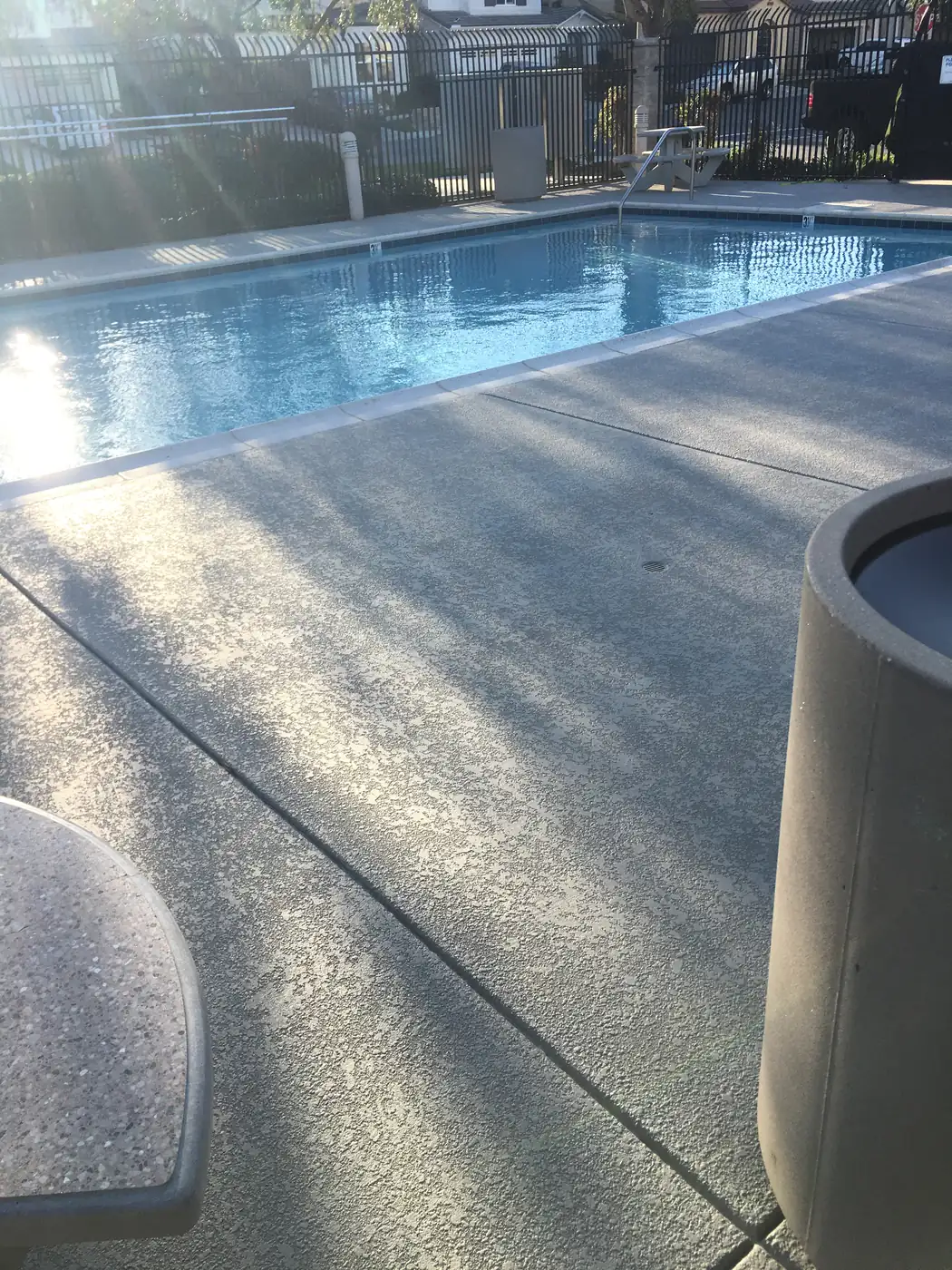
- Knock-down texture. The most common finish. A troweled texture with high and low points that grips underfoot, hides dust and wear, and suits almost any house.
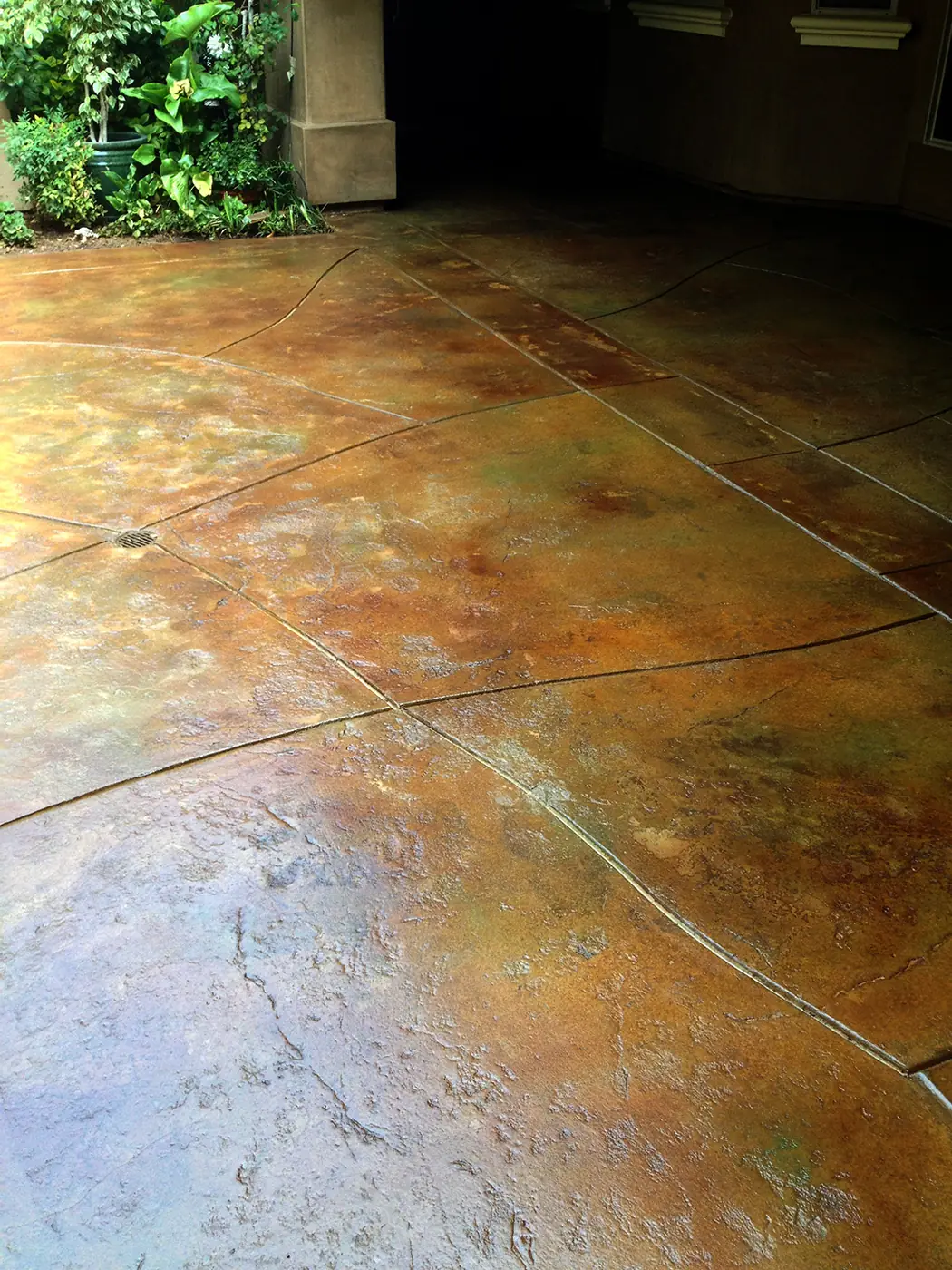
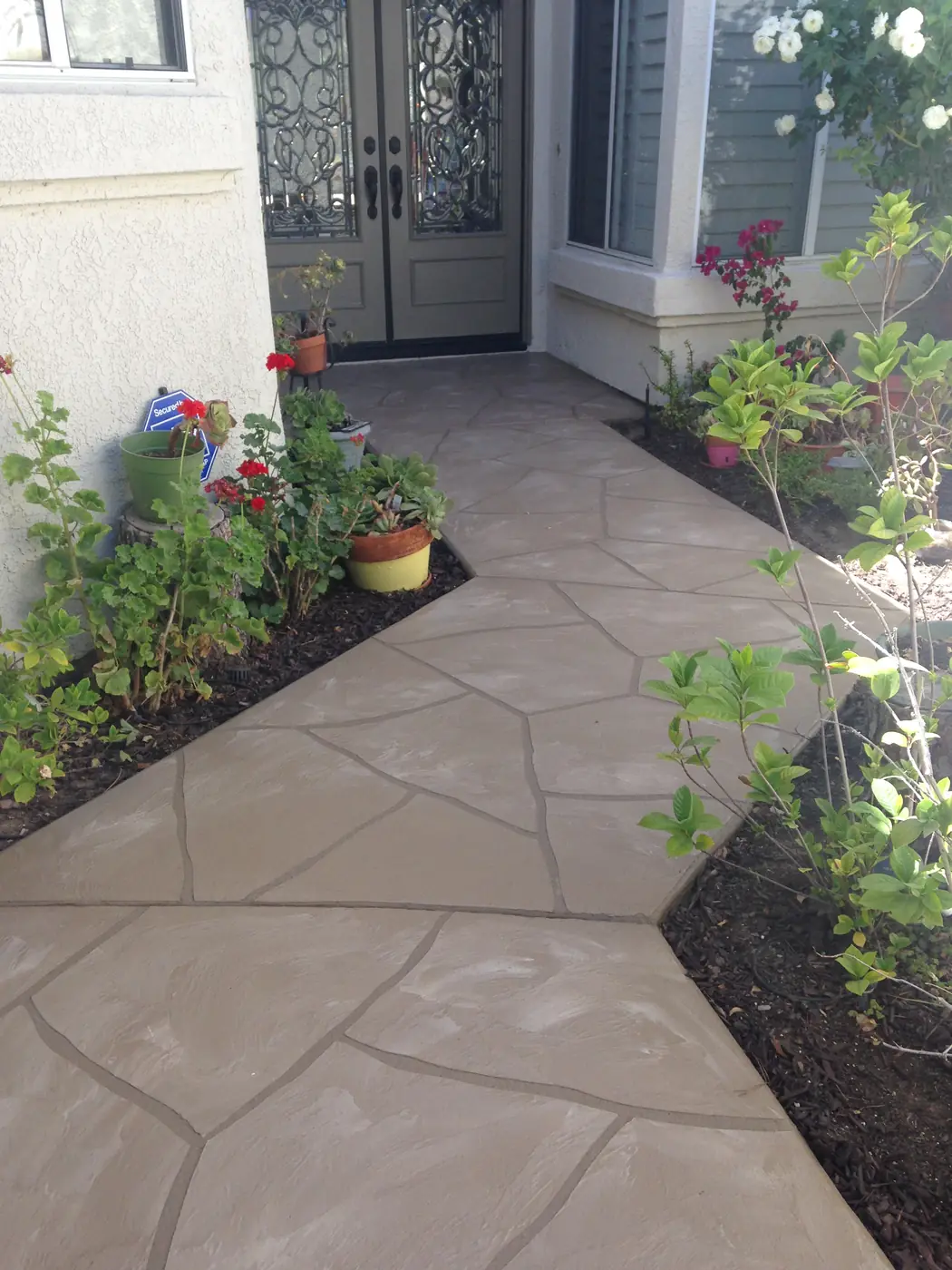
- Flagstone. Irregular stone shapes with hand-cut joint lines. The one in the photo above is a front walkway done this way.
- Tile and brick. Straight-line layouts, grids and borders, good for entries and covered patios where a more formal look fits.
- Cobblestone. Rounded stones in a random set, which reads well on a courtyard or a side yard path.
- Borders and bands. A contrasting edge around a patio or a band across a long walkway, which breaks up a large area and makes it look designed rather than poured.
Color goes in with the overlay or on it afterwards. If you want a variegated, stone-like finish, the overlay can be stained once it is down; we explained the two stain types in acid stain vs water-based stain.
What happens to the cracks
This is the question everyone asks, and the answer is the best thing about a patterned overlay.
A crack in a plain gray slab is a flaw. The same crack running through a flagstone pattern can become a joint line. When we lay out the pattern, we look at where the existing cracks run and draw the stones around them, so the crack sits where a joint would naturally be. Once the overlay is down and colored, it stops reading as damage and starts reading as design.
That only works for cracks that have stopped moving. Hairline shrinkage cracks and old settlement cracks that have not changed in years are fine. A crack that is still opening, or two sections of patio that have lifted or dropped against each other, is active movement, and an overlay will crack along the same line again. We will tell you that at the estimate rather than cover it up. There is more on telling the two apart in resurfacing vs replacing concrete.
Preparation is what makes it last
An overlay is only as good as its bond to the slab underneath. That bond depends entirely on what the concrete looks like before anything goes on it.
- Old sealers, paint and failing coatings come off completely. An overlay bonded to a failing coating fails with it, which is why concrete coating removal is sometimes the first line on the quote
- The surface is mechanically opened up so the overlay has something to grip, not just washed
- Spalled or crumbling areas are cut back to sound concrete and rebuilt before the overlay covers them
- Cracks are cleaned out and filled so they do not telegraph through as a shadow
- Oil, rust and rubber marks are dealt with, because contamination in the slab pushes up into the bond line
None of that is visible when the job is finished, and all of it is the difference between an overlay that lasts and one that delaminates in patches two summers later. Preparation is the part of the trade we have spent fifty years on.
Where an overlay makes sense
Patios and entry walkways. The classic use. A tired front walk becomes the first thing people notice about the house instead of the last.
Pool decks. A textured overlay grips when wet and can be finished in a lighter tone that stays cooler underfoot. If heat is the main complaint, pool deck too hot to walk on covers that side of it, and pool deck resurfacing cost covers the budget.
Driveways. Yes, with the right system and preparation, although a driveway takes more abuse than a patio. On a sound driveway that only needs color, staining is often the simpler answer.
Interior floors. Overlays work indoors too. A patterned overlay gives an interior slab a finished look when the concrete underneath is not good enough to stain or polish on its own; there is a checkerboard diner floor in our gallery done exactly that way.
When an overlay is the wrong answer
We would rather lose a job than sell one that fails. An overlay is not the answer when the slab is actively moving, when large sections have heaved from tree roots, when the concrete is breaking up through its full depth, or when water is pooling against the house because the patio has settled toward it. In those cases the slab itself is the problem, and a new surface on a failing slab is a year of looking good followed by a second bill.
If the concrete is sound, though, an overlay costs less than removal and a new pour, takes a fraction of the time, and gives you a pattern that plain new concrete would not have anyway.
Seeing it on your own patio
Patterns look different at scale than they do in a photograph, so we walk your actual patio with you and talk through where the joints would fall around your cracks. There are more finished overlays in our gallery and details of the process on our microtopping and overlays page.
Our own crews do every stage, nothing is subcontracted, and we cover Riverside, San Bernardino, San Diego, Orange and Los Angeles counties. Book a free on-site estimate and we will tell you honestly whether your patio is a candidate.