Almost every slab we look at has cracks in it. A garage floor with a line running out from the corner of the step, a driveway with a crack across the middle, a patio with a spider web of fine lines near the house. And almost every homeowner asks the same thing on the estimate: if we coat or resurface over that, will the crack just come back?
The honest answer is that it depends on the crack, not on the coating. Some cracks, once they are dealt with properly, stay gone. Others will find their way back through anything you put over them, because the concrete underneath is still moving. Working out which kind you have is the first job.
Why concrete cracks in the first place
Concrete shrinks as it cures. A slab that is poured in one piece will crack somewhere as it does, which is why slabs are cut or tooled with control joints: straight lines that give the shrinkage somewhere tidy to go. When a slab cracks between its joints anyway, or the joints were spaced too far apart, you get the random cracks most people are looking at.
That kind of cracking is normal, and on its own it is not a reason to replace concrete. The cracks that matter are the ones caused by something else: soil that has settled or swelled under the slab, tree roots, water running under the edge, or loads heavier than the slab was built for.
Dead cracks and moving cracks
The useful way to think about a crack is whether it is still moving.
A dead crack opened up while the slab was shrinking and has not changed since. It is usually fine, the two sides are level with each other, and it has looked the same for years. Once it is opened up, cleaned and filled, it can be coated or resurfaced over and in most cases it stays hidden.
A moving crack opens and closes with the seasons, keeps getting wider, or has one side sitting higher than the other. A coating or overlay is bonded to the concrete, so when the concrete moves, the coating moves with it. A rigid finish cannot hold together a slab that is pulling apart underneath it, and the crack will show again along the same line.
A few checks tell you a lot before anyone comes out:
- Is one side higher than the other? A lip you could catch a toe on means the slab has settled or lifted, not just shrunk
- Has it got wider? Compare it with an old photo, or mark the ends with a pencil and check again in a few months
- What is next to it? A tree, a downspout, a planter or a low spot where water sits all point to something going on underneath
- Where does it start? Cracks running from the inside corner of a step, a drain or a post are common and usually shrinkage. Cracks that wander across the middle of a slab with a lip on one side are more likely to be movement
How cracks are dealt with before a coating
On our jobs, cracks are chased, cleaned and filled before anything goes over the top. Chasing means opening the crack out to sound edges rather than smearing filler across the surface of it. A crack that is only skimmed over at the top has a thin line of filler sitting on dust and loose edges, and that is the first place a coating lets go.
The same goes for the edges of the crack. A slab that is being coated is ground first, and the grinding is what shows where the concrete is sound and where the edges of a crack are crumbling. Loose material comes out before the repair goes in.
Joints are not cracks
Control joints are there on purpose, to give the slab a place to crack. Covering a joint with a rigid coating and pretending it is not there tends to produce a crack right along the line, because the slab is still going to move at that joint.
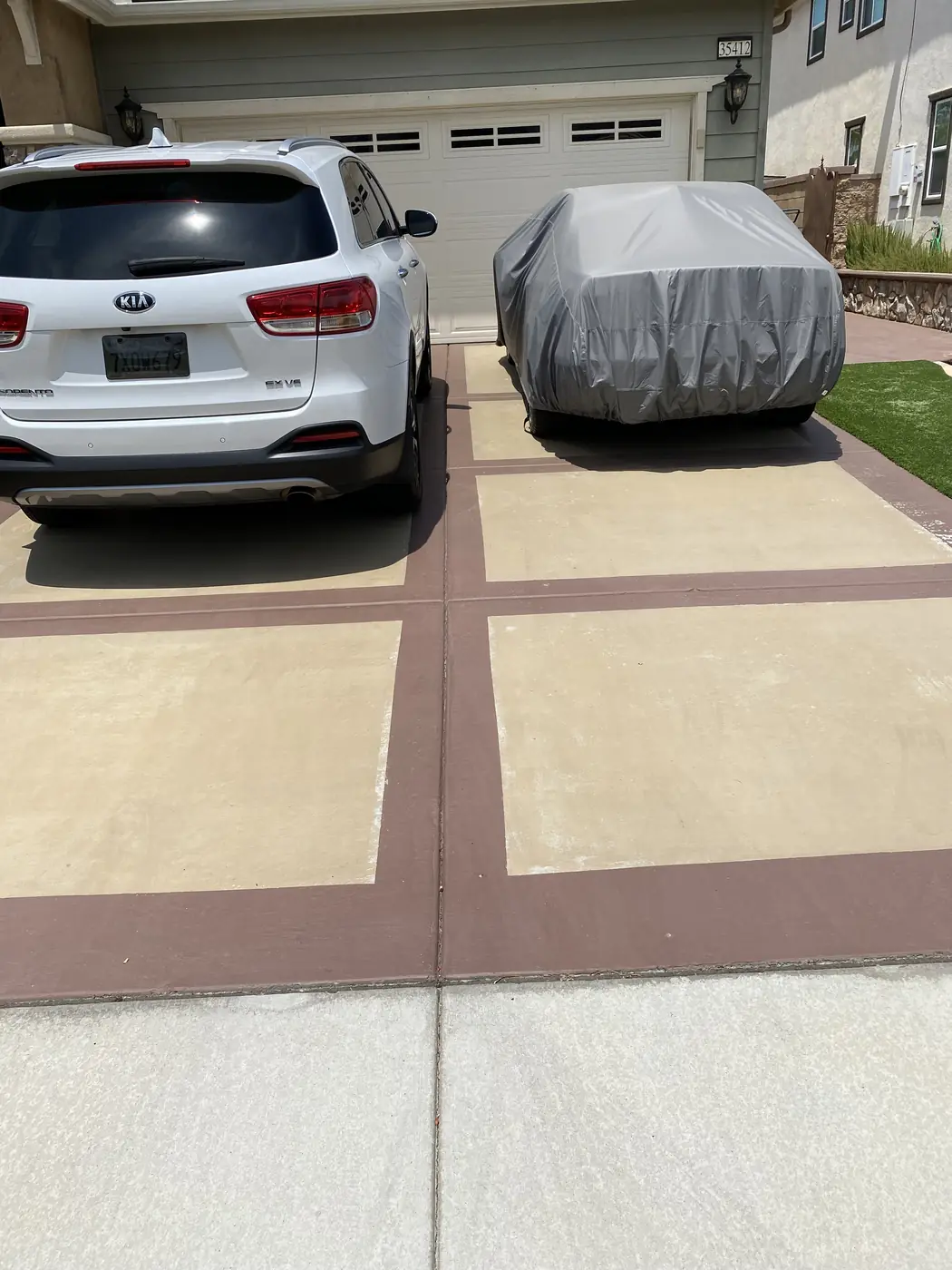
How a joint is handled depends on the slab and the finish. It can be kept open, filled, or carried through the new surface. On a resurfacing job it can even be made into part of the design: the center band on the driveway in the photo above runs straight down the slab's joint line. Whatever the plan, it is a fair thing to ask about on any estimate, and the answer tells you whether the contractor has thought about it.
What different finishes hide
Even a well-repaired dead crack can still be visible depending on what goes over it:
- Flake epoxy hides filled cracks and small imperfections well, which is one reason most garages get it
- A solid color with a clear coat is sharper looking and shows more of what is underneath, including the outline of a repair
- Stain is translucent. It colors the concrete that is there rather than covering it, so filled cracks usually read as lines in the finished floor. Some people like that look. If you would rather not see them, stain is not the finish for a badly cracked slab
- Overlays and microtopping put a new surface over the old one and hide repairs well, but a moving crack underneath will come back through an overlay just as it would through a coating
If you want to compare finishes on cracked concrete, polished concrete vs epoxy and acid stain vs water-based stain cover how each one treats the slab underneath.
When the cracks mean the slab has failed
Some concrete is past saving. A slab broken into pieces that rock underfoot, sections that have dropped or heaved well out of level, or cracks that keep opening because the ground underneath is washing out are not problems a surface finish can solve. They need the cause fixed, and sometimes the section replaced.
That is rare. Most cracked slabs need their surface dealt with, not a jackhammer, and the difference is covered in resurfacing vs replacing concrete. But when a slab has genuinely failed, we would rather tell you on the estimate than sell you a finish that will crack along with it.
What to expect afterwards
Nobody can promise that concrete will never crack again. It keeps moving a little through its whole life, with heat, cold, water and load. What proper crack repair does is deal with the cracks that are there, so that the dead ones stay hidden and the coating stays bonded around them. If something does move later, a well-bonded coating shows it as a fine line rather than peeling away in sheets around it.
And if the cause is outside the slab, such as a downspout emptying against it or sprinklers soaking the edge, fixing that first does more for the finish than anything that goes on top.
Getting it looked at
Cracks are one of the main things Dave looks at on an estimate, because they decide what the prep involves and which finish makes sense. Crack repair is part of every concrete resurfacing and garage floor coating job we do, and patterned finishes are on our microtopping and overlays page. Book a free on-site estimate and we will tell you which of your cracks are dead, which are moving, and what that means for the finish you have in mind.